AI Twin Generation: Stats and Facts (2026)
AI twins are having a moment. Actually, scratch that, they’re having a full-blown growth spurt. Every report screams “exponential,” every founder claims they’re “twin-powered,” and every enterprise deck has at least one slide with a 3D model floating in space. But beneath the buzz, the AI twin stats tell a much more interesting story. One that’s not just big numbers, but real shifts in how systems are built, tested, and optimized.
Let’s break it all down. Read on!
What Is an AI Twin?
AI twins (AI-enhanced digital twins) are virtual replicas of physical systems, processes, or entities. They use real-time data, machine learning, and AI to simulate behavior, predict outcomes, and optimize operations.
In simpler words: A normal digital twin watches. An AI twin thinks, learns, and reacts.
That difference matters. A lot.
Market Context: Why Everyone Suddenly Cares
The global digital twin market (industrial use alone) is expected to grow:
- From $1.86 billion in 2024
- To $1.94 billion in 2025
- And then jump to $2.78 billion by 2033
What this means:
This isn’t hype-driven growth. This is slow, steady adoption turning into long-term commitment. Enterprises don’t casually pour billions into simulation tech unless it saves money, time, or both. Now add AI into the mix.
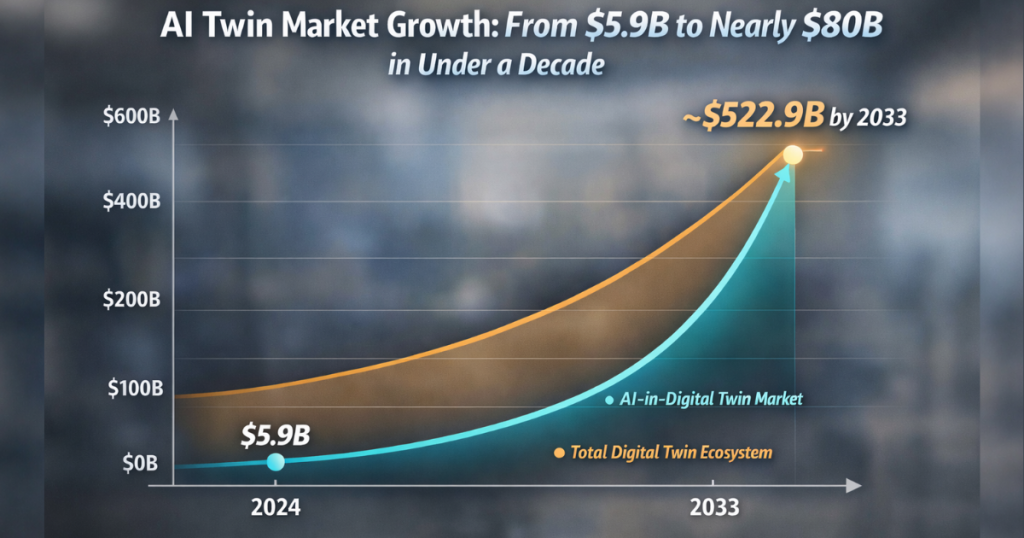
The AI-in-digital-twin market was valued at $5.9 billion in 2024 and is projected to reach nearly $80 billion by 2033.
Yes, that jump is real.
What it means:
AI is not an “add-on” anymore. It’s the main engine. Without AI, digital twins stay static. With AI, they become decision-makers.
Market Size & Growth: Why Forecasts Are All Over the Place
If you’ve Googled stats for AI twin creation, you’ve probably noticed something odd. Every report shows a different number. That’s not an error. It’s perspective.
Here are the big ones:
- $10.3 billion in 2023 → $61.4 billion by 2032 (22.1% CAGR)
- $17.3 billion in 2025 → $123.2 billion by 2035 (21.7% CAGR)
- One wild projection suggests $522.9 billion by 2033 (46.1% CAGR)
What this means:
Some reports count only industrial twins. Others include IoT, smart cities, healthcare & fitness, retail simulations, etc.
So when you see a massive number, it’s not wrong. It’s just… broad. Very broad.
Read More: How to Create AI Videos with Your AI Twin: Step-by-Step
AI Integration in Digital Twins: The Real Turning Point
Here’s a stat that quietly explains everything:
Around 52% of organizations already using digital twins have integrated AI capabilities.
What this means:
We’re past the experimentation phase. This isn’t “let’s test a pilot.” Half the market is already running AI-powered twins in real workflows. That’s huge.
With AI onboard, twins can:
- Learn from historical data
- Adapt to real-time changes
- Predict outcomes instead of reacting after damage is done
This is where digital twins stop being mirrors and start being brains.
Adoption Across Industries
Let’s take a look at numbers across industries and see who’s moving fast (and who’s catching up) –
Manufacturing: 48–50% of manufacturers plan to add AI to their digital twins.
What it means:
Factories are sick of downtime. AI twins help predict machine failures before something breaks. That’s not innovation fluff but survival.
Automotive: Around 57% of automotive firms are integrating AI twins.
What it means:
Crash simulations, safety testing, production optimization. Cars are expensive to mess up. Virtual testing saves millions, sometimes billions.
Other Industries: Architecture, oil & gas, aerospace, city planning: 35–50% planned adoption
What it means:
Anything expensive, regulated, or dangerous benefits from AI twins. Which is… most industries, honestly.
Performance & Efficiency Gains: Where the Money Actually Shows Up
Now let’s talk results. Not “potential,” but reported outcomes.
Reduced Downtime: AI twin users report up to 20% fewer unexpected stoppages.
What this means:
Less panic, fewer midnight calls, and more predictable operations.
Efficiency Improvements: Manufacturing metrics improve by 15–25%.
What this means:
Faster cycles. Lower waste. Better output without hiring 200 more people.
Sustainability Gains: Around 16% improvement in sustainability metrics.
What it means:
Lower energy usage, smarter resource planning, fewer emissions.
These aren’t tiny gains. These are career-making numbers.
Adoption & Investment Trends: Big Companies Are Not Waiting
Here’s a stat that should stop any “AI twins are early-stage” argument:
70% of large enterprises are actively exploring or investing in digital twin technology.
75% of large enterprises are investing in digital twins specifically to enhance AI-driven decision-making.
What this means:
Enterprises trust AI twins more than dashboards. Because dashboards explain the past. AI twins predict the future. Big difference.
Predictive Analytics & Maintenance: The Killer Feature
This is where AI really earns its keep.
AI use:
- Historical data
- Sensor data
- Real-time operational data
To predict failures before they happen.
Reported results:
What this means:
Maintenance shifts from “fix when broken” to “fix when predicted.” That’s cheaper, safer, and way less stressful.
Real-World Use Cases
Here are real brands incorporating AI twins in their work –
1. Rolls-Royce
Rolls-Royce is one of the cleanest real-world examples of AI twins done right. They use AI-powered digital twins to monitor aircraft engines in real time using live sensor data. The AI twin constantly compares how an engine should behave versus how it actually behaves mid-flight. If something looks even slightly off, it predicts a failure before it happens.
What it means: jet engines don’t get retries. One missed issue can ground fleets or worse. AI twins turn maintenance from reactive to predictive, saving millions and improving safety.
2. Smart Cities
Smart cities use AI twins in a very different, very human way. Traffic systems feed real-time data into AI twins that simulate congestion patterns and adjust signals dynamically.
What it means: smoother traffic, fewer idling cars, lower emissions, and yes, fewer people screaming at red lights.
Geographic Adoption Patterns: Who’s Leading
Here’s what the numbers say about the geographical adoption of AI twins –
North America currently holds around 35% of the global digital twin and AI twin market share.
What this means is simple: early cloud adoption, strong enterprise spending, and heavy investment in AI research gave the region a head start. Big industries moved first, and they moved fast.
Europe and the Asia-Pacific are close behind and growing quickly. Adoption here is being driven by manufacturing-heavy economies, smart infrastructure projects, and government-backed digital transformation initiatives. Countries focused on automation, smart cities, and industrial efficiency are scaling AI twin generation at a pace.
Challenges & Limitations
Let’s be honest for a moment. AI twins are powerful, but they’re not plug-and-play magic.
1. Cost is the first hurdle.
Large-scale AI twin deployments can easily cross the $1 million mark, especially when you factor in sensors, data pipelines, AI models, and ongoing maintenance.
What this means: this is still enterprise-first technology. Smaller, SMB-friendly versions are emerging, but they’re not universal yet.
2. Data and security come next.
AI twins depend on clean, continuous data. Legacy systems, poor integrations, privacy concerns, and inconsistent data quality can slow things down fast.
What this means: an AI twin is only as good as the data behind it. Feed it bad inputs, and it will deliver very confident, very wrong insights.
Future Outlook & Market Forecasts: Where This Is Headed
Looking ahead, the AI twin stats point to one clear theme: acceleration. And not the slow, cautious kind.
The AI-enhanced digital twin market, valued at $5.9 billion in 2024, is projected to surge to nearly$79.8 billion by 2033.
What this means: This signifies that the digital twins are evolving from being mere representations to being co-analysts and decision makers that are highly interactive and intelligent, guided by AI.
If we zoom out even more, the view becomes wider. The entire digital twin environment, which is driven by IoT, AI, cloud computing, and advanced analytics, could be worth $522.9 billion by 2033.
What this means: AI twins won’t be a niche tool. They’ll become foundational infrastructure across industries, quietly running the systems we depend on every day.
Emerging Trends: What’s Next (And Kinda Inevitable)
Here’s where AI twin generation is clearly heading next, based on current market movement and adoption patterns:
- Hybrid AI twins that learn and adapt in real time are becoming the norm. These systems don’t just simulate outcomes; they continuously evolve, making them ideal for autonomous systems and smart infrastructure.
- The combination of augmented and virtual reality with AI twins is making it possible to create realistic simulations. It is possible for engineers and operators to get into the virtual worlds for training, testing, and predicting the results before interfacing with the actual systems.
- AI twins that rely on edge computing are becoming more popular as they process the data closer to the source, which leads to quicker decisions and lower latency.
- Human and operational AI twins are expanding beyond machines, modeling workflows, teams, and decision behavior.
Smarter, faster, more autonomous. That’s the direction.
Must Read: How to create an AI digital twin?
Conclusion: The Numbers Don’t Lie (Even If People Do)
Let’s recap:
- Massive market growth across every forecast
- Over 50% AI integration is already happening
- 15–25% efficiency gains
- 20–30% reductions in downtime and maintenance
- Strong enterprise investment momentum
AI twin generation stats aren’t just big numbers for slides. They signal a shift in how systems are designed, tested, and optimized.
From manufacturing floors to smart cities, AI twins are quietly becoming the decision layer beneath modern infrastructure.
And based on current stats for AI twin creation, this is still early innings. The next few years? Yeah… things are about to move fast. Probably faster than most people expect.
Written by:

Neeraj is passionate about reshaping brand storytelling through AI-powered UGC videos. As the Founder he helps brands unlock authentic, creator-style video content that drives results - without the traditional time, cost, or complexity. His approach blends AI innovation with marketing performance to scale engagement efficiently.