How to Create AI UGC Videos for Home Decor Brands







TL;DR: Home decor has a problem no other category deals with quite the same way: buyers can’t tell if a rug, lamp, or sofa will actually look right in their room until it’s already in their room. That uncertainty is why return rates for home and furniture sit at 8 to 20% industry-wide, and why “didn’t match what I expected” is the single biggest return reason in the category.
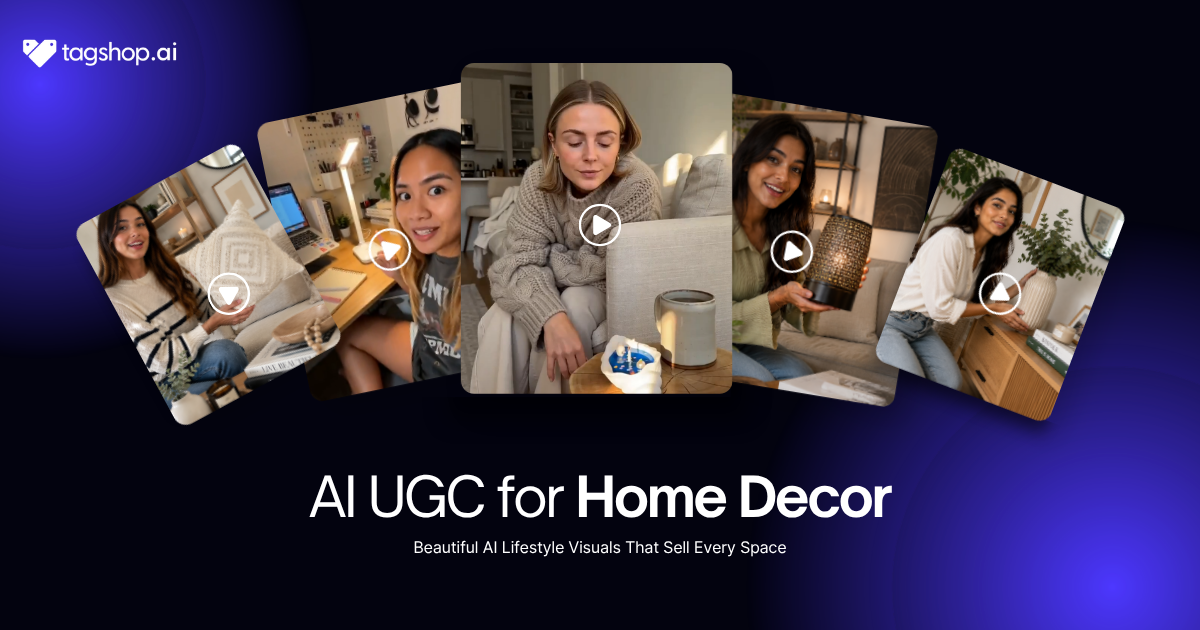
AI UGC fixes this at the source: instead of one styled shoot, you generate the home decor UGC video across dozens of real-feeling room setups, aesthetics, and use cases, at a fraction of the cost and time. Done right, it doesn’t just cut production costs. It cuts the doubt that was costing you the sale (and the return) in the first place.
Every Home Decor Brand Says the Same Three Things on a Call
If you’ve run outreach or demos for a decor brand, you’ve heard some version of these three lines. We have too:
- “Our shoots are too expensive.”
- “Our content doesn’t convert because buyers can’t visualize it.”
- “We can’t keep up with seasonal content.”
None of these are content problems in the way most people think. They’re a volume and context problem. A single styled photoshoot gives you one room, one lighting setup, one aesthetic.
Your customer base doesn’t live in one room. They live in a hundred different ones: small apartments, sunlit lofts, dark rental units, minimalist spaces, maximalist ones. One hero shot can’t do that job, no matter how good the photographer is.

Why One Photoshoot Can Never Be Enough for Home Decor
Other categories can get away with a handful of product shots. Home decor can’t, for three reasons:
The Stakes are Spatial
A shirt fits or it doesn’t. A lamp has to fit an entire room’s proportions, light, and mood. That’s a much harder thing to communicate in a single image.
The Catalog is Wide, the Budget isn’t
A decor brand might carry 50 to 150 SKUs across categories (lighting, textiles, furniture, wall decor). Shooting each one properly, in multiple settings, with a stylist and a studio, isn’t a marginal cost. It’s a full production line.
The Return Math is Brutal
Furniture and home goods sit at an 8 to 20% return rate depending on the source you check, and the primary driver isn’t damage or fit in the clothing sense, it’s color, material, or scale not matching what the buyer pictured.
Every mismatched return also isn’t just a lost sale; it typically costs the brand $275 or more per unit once restocking, damage, and logistics are factored in. And the trust hit compounds: a majority of shoppers say a bad returns experience makes them less likely to buy from that brand again.
So the actual problem statement is: buyers need to see the product in a version of their own space before they’ll trust it enough to buy. That’s not a photography problem. That’s a volume-and-context problem, and it’s exactly the thing AI UGC is good at solving.
What AI UGC Actually Fixes (And Where It Still Needs You)
Worth being straight about this, because there’s a lot of noise online claiming AI UGC ad is a magic content button. It isn’t. One of the more grounded takes going around AI UGC communities right now put it well: the tool handles the cheap, repetitive part of content production well. The strategic part, knowing which angle, which room style, which “problem” to lead with, is still a human job. Volume without a strategy behind it doesn’t move numbers on its own.
What AI UGC does remove is the bottleneck between “we have an idea for a new angle” and “we have a video testing that angle.” For home decor specifically, that means:
- One product can exist across a boho apartment, a Scandinavian-style living room, a small studio, and a family home, without four separate shoots.
- You can test “does this convert better shown in daylight or evening lighting” without booking a studio twice.
- Seasonal refreshes (festive, monsoon, new-launch) stop being a scramble and become a same-day turnaround.
One DTC home decor brand documented replacing roughly $6,000/month in content production by generating over 700 lifestyle-style product images across 120 SKUs in about two weeks using AI UGC-style generation. That’s the kind of volume-to-cost shift that simply wasn’t possible with a traditional shoot pipeline.
“We had a client who could only ever afford to shoot their bestseller. Everything else sat with one bad phone photo. Once they ran the whole catalog through AI UGC, their second and third bestsellers weren’t even products they’d bet on; they’d just never been shown properly before. That’s when it clicked for me: most catalogs aren’t underperforming, they’re just under-shown.” – Neeraj, Founder, Tagshop AI
Follow These Steps to Make AI UGC for Home Decor
Here’s the practical version, using Tagshop AI’s Video Agent 2.0 (this is the same flow whether you’re doing lighting, furniture, textiles, or wall decor):
Step 1: Give it your idea and your product
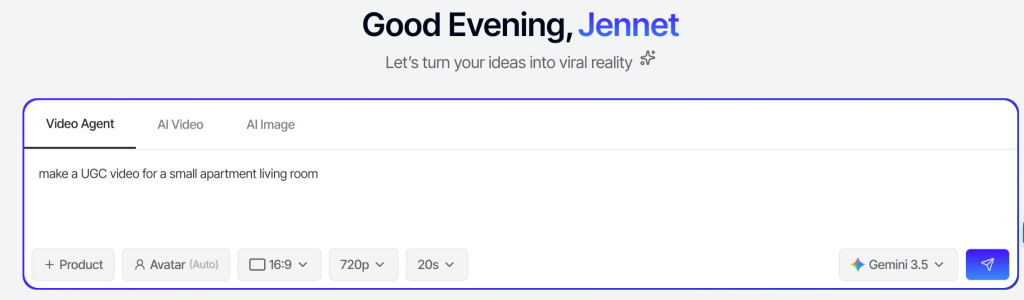
Open the AI video agent and type what you want in plain language, something like “Make a UGC video for a small apartment living room.” Paste the product URL and it pulls in the description and images automatically (or add them manually).
Then set your format, aspect ratio, resolution, and length, anywhere from 4 seconds to a full 60. For decor specifically, don’t default to the shortest option: a room reveal often needs a few extra seconds to land the “before” before the payoff.
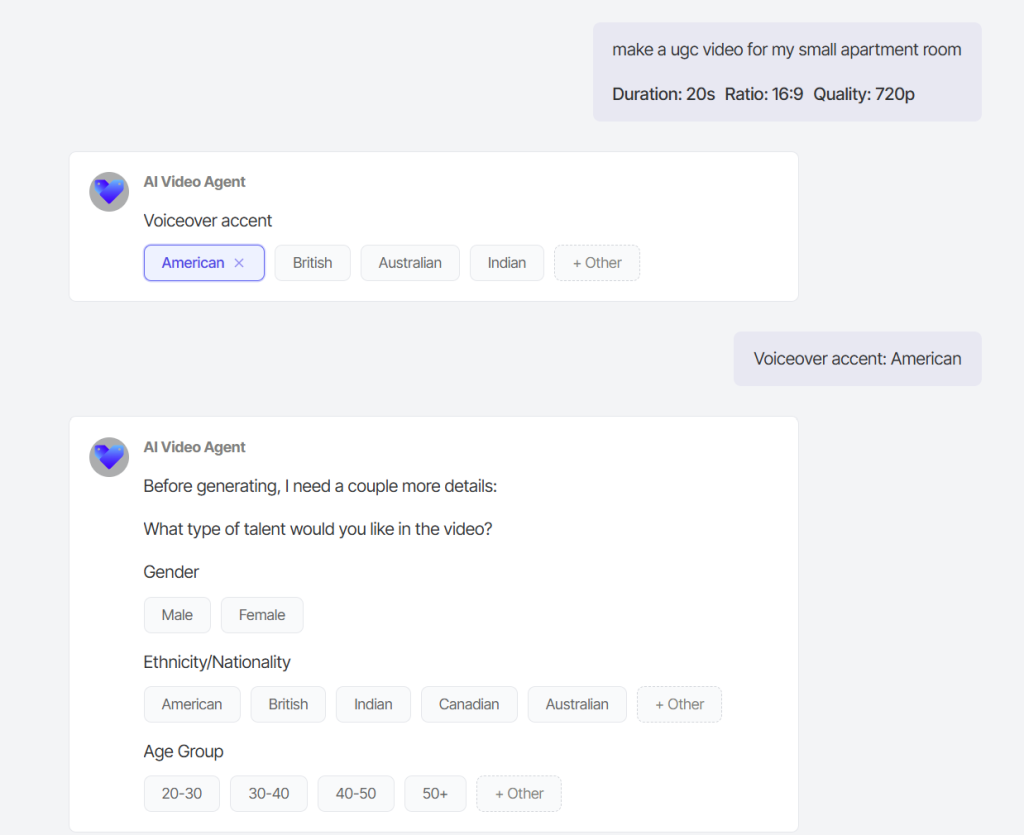
Step 2: Answer the follow-ups, then review the storyboard.
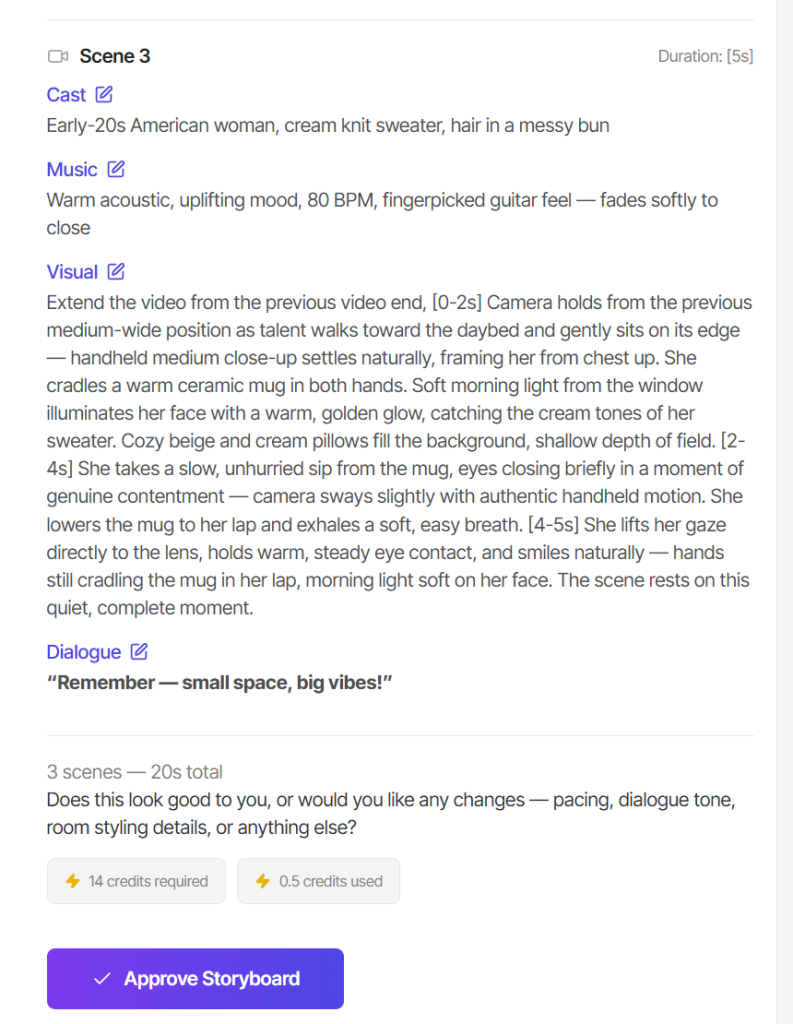
The Agent asks about your audience, tone, and message before building anything, answer like you’re describing the video to a friend, not writing ad copy. Then you’ll see the full scene-by-scene plan before anything renders. This is where you catch the wrong room vibe or a shot that feels too staged: just say “make this room feel more lived-in” or “cut the studio-style shot in scene 2,” and that scene updates without touching the rest.
Step 3: Generate, fine-tune, and post.
Once the storyboard looks right, generate the video. If one scene still isn’t landing once you see it in motion, regenerate just that piece instead of starting over. Export and publish wherever your audience actually is.
The reason this matters for decor specifically: you can run the same product through this flow multiple times with different room-style instructions and end up with a genuine content library instead of one asset stretched across every ad set.
Steal These Prompts for Your Next Home Decor Ad
Swap in your product and room details:
The “problem-first” hook:
“Create a UGC-style video of a person in a small, dimly-lit apartment living room complaining that the space feels cramped and dark, then discovering [product] and reacting to how it opens up the room. Casual, handheld, slightly imperfect framing, real-talking-to-camera tone, not polished ad-style.”
The “before I show you this” honesty hook:
“Create a UGC video where the creator says they were skeptical about buying [product] online without seeing it in person, then shows it installed/placed in a [room style] living room, and gives an honest, specific reaction to texture, size, or color accuracy.”
The seasonal refresh prompt:
“Generate a UGC-style video showing [product] styled for a [festive/monsoon/summer] home refresh, in a [room style] setting, with the creator giving quick styling tips a viewer could copy.”
The room-transformation prompt:
“Create a before-and-after style UGC video: same room, before [product] (bare, plain, or dated) and after (styled with the product), narrated by the creator explaining what changed and why it made the space feel different.”
5 Rules for AI UGC That Doesn’t Look Like AI
- Match the room to the buyer, not the brand aesthetic. A luxury-styled loft doesn’t build trust with someone shopping for a studio apartment. Generate across the room styles your actual customers live in.
- Keep the imperfections. The most-referenced advice from creators actually running AI UGC campaigns is to make it feel “less perfect,” not more. Slight handheld movement, natural pacing, and a normal room (not a showroom) read as more credible than anything polished.
- Lead with the specific doubt, not the product spec. “Will this actually fit my space” beats “premium oak finish” every time in decor. The Reddit threads on this are consistent: AI UGC that performs well leads with a relatable doubt, not a feature list.
- Treat it as a testing engine, not a one-and-done asset. The value isn’t one great video, it’s the ability to run five room-style variants of the same product and let the data tell you which context actually converts.
- Don’t skip human review on the storyboard step. The strategic call, what doubt to lead with, what room style fits the audience, still needs a person making that decision. That’s the part AI doesn’t replace.
The Real 10x Isn’t More Videos. It’s This.
User-generated and UGC-style content consistently outperforms traditional product ads on conversion, with multiple 2026 industry reports citing lifts anywhere from roughly 25% to well over 100% depending on category and placement. Home decor sits in a category where that gap is likely to be even more pronounced, because the core buying hesitation (can I actually picture this in my home) is exactly what UGC-style, in-context content is built to resolve.
The brands winning here aren’t the ones producing the most content. They’re the ones producing content that matches how fragmented their customers’ actual homes and tastes are, then using the data from that volume to keep sharpening the angle. That’s the real “10x,” not more videos, but more accurate answers to “will this look right in my space” reaching more of the right people, faster than a traditional shoot pipeline could ever move.
Frequently Asked Questions
AI UGC is creator-style video or image content generated from a product link and a brief, rather than filmed with a human creator. For home decor, that means the same lamp, rug, or sofa can be shown across multiple room styles and lighting setups without booking a new shoot for each one.
It’s effective for a different job. Real customer reviews and testimonials still carry the most trust for social proof. AI UGC is best used for scaling top-of-funnel and consideration-stage content, in-context product videos, seasonal refreshes, and testing new angles, where volume and speed matter more than it being a specific, named customer.
A single studio shoot for one product in one setting typically runs from a few hundred to several thousand dollars once styling, location, and editing are included. AI UGC tools generate multiple room-style variants of the same product for a fraction of that, which is why one documented case replaced roughly $6,000/month in production costs while generating 700+ lifestyle images across 120 SKUs.
There’s no blanket legal requirement the way there is for real estate virtual staging, since a decor product ad isn’t misrepresenting a physical property a buyer will inspect. That said, being transparent when directly asked builds more trust than it costs, and platforms are increasingly adding their own AI-content labeling requirements, so check current policy on whichever ad platform you’re running on.
Start with your best-selling SKU and generate 3 to 4 room-style variants (different aesthetics, different lighting) instead of one polished version. Run them against each other as ad variants and let inquiry or click data tell you which room context actually resonates with your specific audience before scaling to the rest of the catalog.
Written by:

Prakash Rawat is a digital marketer at Tagshop AI with 6+ years of experience across SEO, performance marketing, and AI-powered growth tools. He specializes in applying AI-driven strategies to optimize visibility, accelerate scalable growth, and drive adoption of next-generation marketing technologies.
 Add Tagshop.ai as a preferred source in Google Search







 Introducing

 Wan 3.0 is now live on Tagshop AI