AI UGC Video Stats and Facts (2026)
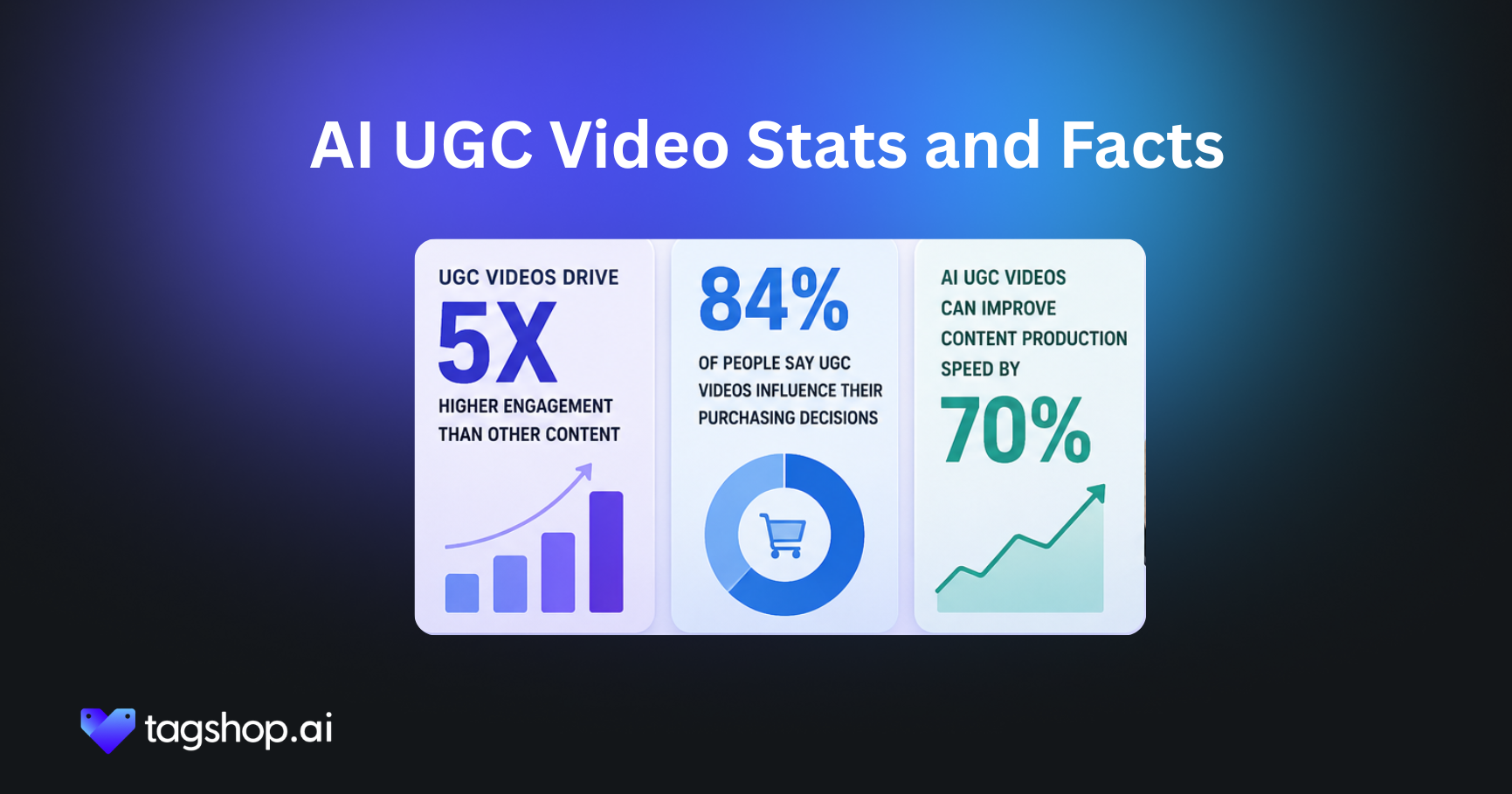







AI-generated UGC has stopped being a novelty. By blending the authenticity of user-generated content with the speed and scale of AI, brands now produce creator-style video for a fraction of what it used to cost, and audiences keep responding to it. This guide pulls together the most important AI UGC video stats and facts for 2026, from market size and adoption to advertising performance, consumer trust, and the new disclosure rules you can’t ignore.
The one-line takeaway: AI UGC video works because of economics, not magic. Videos that once cost thousands and took two weeks now take about 27 minutes and cost almost nothing, which lets teams test far more creative and pour real budget into what actually performs.
What is an AI UGC video?
An AI UGC video is one that looks and feels like user-generated content but is produced with AI. Think of someone speaking face-to-camera, casually and unscripted in tone, about a product or experience: a review, a testimonial, or an influencer-style ad, except the “creator” is AI-generated.
The appeal is operational. Mid-tier human UGC creators charge roughly $150 to $500 per video, while AI UGC can come in under $50 per video on current platforms. For a performance team running 20 to 50 creative variations a month, that gap is the whole story. What changed in 2026 is the quality threshold: content that looked obviously artificial two years ago now passes the scroll test for most viewers.
Cost and time savings: the clearest part of the story
The efficiency numbers are where AI UGC is hardest to argue with:
- Production cost fell roughly 97% from 2020 to early 2026 — from about $1,500 per freelance project to under $15 with AI tools.
- Average time to produce a 60-second marketing video dropped from ~13 days to ~27 minutes.
- Businesses saved an estimated $3.7 billion globally by switching to AI video in 2025.
- Companies with fewer than 50 employees account for 46% of all AI video platform sign-ups, so the savings matter most to the smallest teams.
The practical test is simple. Ask three questions: what does one video cost you, how many do you test a month, and how long does it take to publish one? If video is expensive, slow, and hard to iterate on, AI UGC is worth trying.
Hook Stat:
- 68% of marketers believe AI-generated video content will be a standard in marketing strategies by 2026. (Source: Forrester, 2023)
Global Adoption of AI UGC Videos
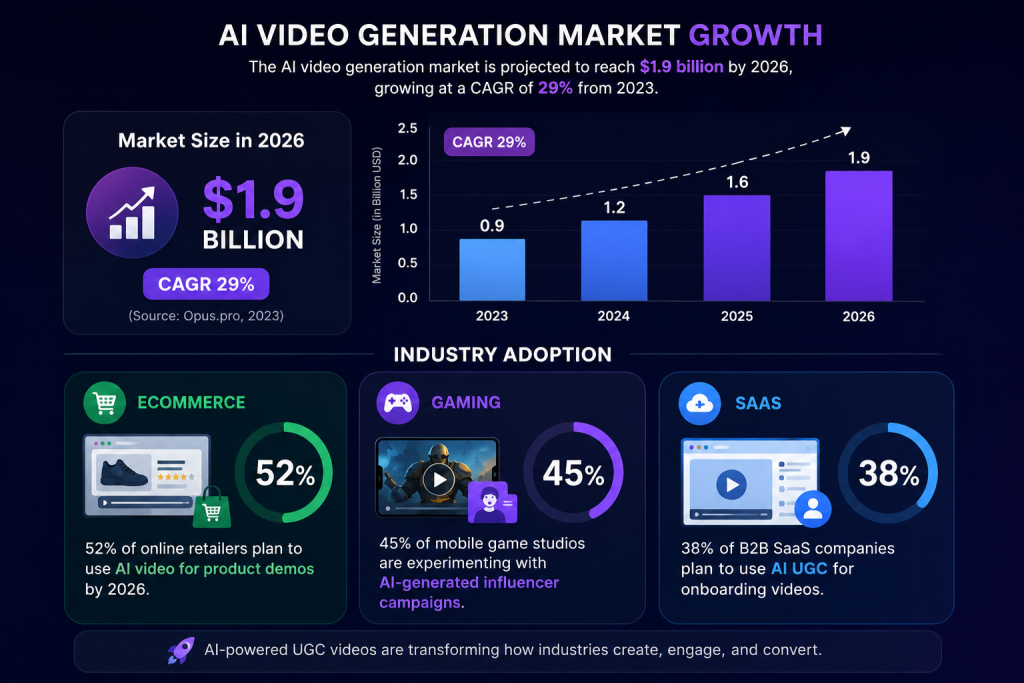
- Market Growth: The AI video generation market is projected to reach $1.9 billion by 2026, growing at a CAGR of 29% from 2023. (Source: Opus.pro, 2023)
- Industry Adoption:
- Ecommerce: 52% of online retailers plan to use AI video for product demos by 2026.
- Gaming: 45% of mobile game studios are experimenting with AI-generated influencer campaigns.
- SaaS: 38% of B2B SaaS companies plan to use AI UGC for onboarding videos.
Comparison:
- AI-generated UGC reduces video production time by up to 70% and costs by 60–80% versus traditional UGC campaigns. (Source: Eevy.ai, 2023)
The AI video generator market hit $716.8 million in 2025 and is tracking toward $847M to $946M in 2026, growing at a 20.3% CAGR from 2026 to 2033. For context, the broader video editing software market grows around 5.2% a year, so AI video is expanding roughly 3.6x faster than the category it’s eating into.
Usage has scaled with it. Monthly active users on AI video platforms crossed 124 million in January 2026, and these aren’t enterprise-only numbers; solo creators and small operators make up a meaningful share. Fiverr’s Fall 2025 Business Trends Index reported that demand for AI video creators surged 66% in six months.
By industry, e-commerce and retail are the fastest-growing vertical at a projected 22.8% CAGR, fueled by product demos, multilingual variations, and high-volume creative testing. Education, real estate, and healthcare follow, while trust-heavy industries move more cautiously. Looking ahead, 68% of marketers expect AI-generated video to be a standard part of marketing strategy (Forrester).
Quick Stats at a Glance
| Metric | Number |
|---|---|
| AI video generator market size (2025) | $716.8M |
| Projected market size (2026) | $847M–$946M |
| Market CAGR (2026–2033) | 20.3% |
| Monthly active AI video platform users (Jan 2026) | 124 million |
| Marketing teams using AI video quarterly | 78% |
| Production cost reduction vs. traditional | up to ~91% |
| Time to produce a 60-second video with AI | ~27 minutes (vs. ~13 days) |
| UGC-style ads vs. polished creative: CTR lift | +33% |
| UGC posts: conversion rate vs. non-UGC | 10.38x |
| Consumers who trust peer/UGC over branded content | 92% |
| Consumers who can spot AI video | 83% |
AI UGC in Marketing
- Engagement rates: AI UGC videos see 2–3x higher engagement than branded studio videos in social feeds. (Source: HubSpot, 2023)
- Conversion: Brands using AI UGC for product videos report up to 25% higher conversion rates on landing pages.
- Popular use cases:
- Product demos – 62% of brands plan to use AI-generated product demos.
- Customer testimonials – 48% adoption.
- Influencer-style ads – 37% adoption.
AI UGC in Advertising
- Paid ad performance:
- CTR increases by 18% for AI-generated UGC ads versus traditional video ads.
- ROAS increases by 20–25% in ecommerce campaigns. (Source: Social Media Examiner, 2023)
- Speed & testing: AI allows brands to generate 10–15 ad variations in hours instead of weeks.
Social Media Impact
- Platform engagement:
- TikTok: AI UGC videos get 3.1x higher watch-through rates than brand studio videos.
- Instagram Reels: 2.4x higher saves and shares for AI UGC.
- YouTube Shorts: AI-generated product videos increase click-throughs by 15–20%.
- Audience perception: 61% of Gen Z users report they are more likely to engage with videos that feel authentic, including AI-generated UGC. (Source: Business Insider, 2023)
Platforms & Channels Driving AI UGC Adoption
- Social media: TikTok (62%), Instagram Reels (55%), YouTube Shorts (45%), Meta Ads (38%).
- Ecommerce: Shopify and Amazon increasingly support AI-generated product videos.
- Channel strategy: Brands combining AI UGC for organic + paid distribution see up to 2x engagement lift compared to organic-only campaigns.
ROI & Performance Benchmarks
- Engagement uplift: AI UGC videos increase engagement by 30–50% across channels.
- Conversion: Landing pages featuring AI UGC have 10–25% higher conversion rates than static images or traditional video.
- Cost/time savings: AI UGC reduces production cost by 60–80% and video creation time by 70%. (Source: Eevy.ai, 2023)
Consumer trust and the authenticity question
This is where the picture gets more nuanced. 92% of consumers trust peer-created content over branded content, which is exactly why UGC works. But trust in AI specifically is shakier:
- 83% of consumers say they can recognize an AI-generated video, and for 36%, that recognition lowers brand trust.
- An April 2026 MyTSV report identified an “AI fatigue” trend, with users downranking artificial-feeling videos that saw 20 to 35% lower engagement than human-created ones ([MyTSV — verify source]).
- Animoto‘s 2026 State of Video report found 78% of consumers consider videos with real people more trustworthy than AI-generated ones.
Younger audiences are somewhat more tolerant, 47% of 18-to-30-year-olds trust AI-generated information versus 43% across all ages, but Gen Z is also sophisticated at reading production quality. They tend to forgive AI when it’s clearly labeled, and punish it when it pretends to be human.
- 59% of consumers report they trust AI-generated product videos if they feel authentic.
- Demographics: Gen Z and Millennials are most receptive to AI UGC, with 65% likely to engage versus 45% for older generations.
- Purchase influence: 47% of consumers say AI-generated testimonial videos influence their buying decisions. (Source: Forrester, 2023)
Future Trends & Predictions
- AI UGC adoption is forecast to grow 3–5x in the next 3 years.
- Integration with AR/VR: AI avatars creating immersive experiences.
- Platform focus: TikTok, Instagram, and YouTube remain primary channels.
- Challenges: Balancing authenticity with AI automation, addressing ethical concerns.
Disclosure and regulation: no longer optional
Labeling AI content is now a legal question, not just an ethical one. A wave of rules is taking effect:
- New York’s AI content disclosure law took effect in December 2025 (New York State Senate).
- California’s SB 942 (AI Transparency Act) arrived in January 2026 (California Legislative Information).
- The EU AI Act’s Article 50 requirements for consumer-facing AI content take effect in August 2026 (EU AI Act, Article 50).
- China has required metadata and visible labeling since September 2025.
Running AI UGC across markets without reviewing your disclosure obligations is a real legal risk. Brands that build clear internal guidelines now are getting a head start on compliance.
Conclusion
AI-generated UGC is no longer a novelty—it’s becoming a critical tool for marketers, advertisers, and social media managers. Brands that adopt AI UGC early can reduce costs, boost engagement, and scale personalized video content across channels.
Written by:

Neeraj is passionate about reshaping brand storytelling through AI-powered UGC videos. As the Founder he helps brands unlock authentic, creator-style video content that drives results - without the traditional time, cost, or complexity. His approach blends AI innovation with marketing performance to scale engagement efficiently.
 Add Tagshop.ai as a preferred source in Google Search







 Introducing

 Wan 3.0 is now live on Tagshop AI