How to Plan AI UGC Video Script: Formats and Hooks that Convert







Quick answer: To script an AI UGC video ad that converts, keep it to 15 to 30 seconds (roughly 40 to 80 spoken words), open with a hook that fires on three channels at once (what they see, what they hear, and what they read in the first three seconds), then follow a simple structure: hook, problem, solution, proof, and a single clear call to action.
The part most guides skip is that you are writing for an AI voice and an AI avatar, not a human creator, so you script for the ear, keep sentences short and lip-sync-friendly, and make sure the hook is spoken out loud, not just shown as on-screen text. Below is the full method, a hook swipe file, and three complete example scripts you can copy.
TL;DR
- Length: 15 to 30 seconds, about 40 to 80 spoken words. Short enough to hold attention, long enough to make one point well.
- The hook is three channels at once: a visual interrupt in the first second, a spoken opening line by the second, and bold on-screen text by the third. Silent scrollers read, sound-on viewers hear, and both should get the promise instantly.
- Structure that works: Hook, Problem, Solution, Proof, Call to action. Pick a framework (PAS, AIDA, or Hook-Problem-Solution-Proof-CTA) based on how aware your audience already is.
- The AI-specific rules most guides skip: write for a voice engine (short lines, natural punctuation for pacing, no tongue-twisters), match the script to the avatar’s persona and age, and make the hook spoken, not just captioned.
- Hooks earn attention, structure and offer to earn the sale. The best hook pre-qualifies the right viewer instead of baiting any viewer, so a curiosity hook that pulls the wrong crowd will kill your conversion rate.
- Skip the heavy prompting: Tagshop AI’s Video Agent asks a few smart follow-up questions, builds the storyboard for you, and renders the finished ad, so you turn a rough idea into on-brand variants in minutes and can actually test at volume.
I Have Written Hundreds of These. The script is where you win or lose ads.
I have spent the last couple of years writing and testing UGC ad scripts, first for human creators and then for AI avatars, and I can tell you the uncomfortable truth up front: the tool barely matters anymore. Avatar quality has flattened out across every platform. What separates an ad that prints money from one that burns it is the script, and inside the script, the first three seconds.
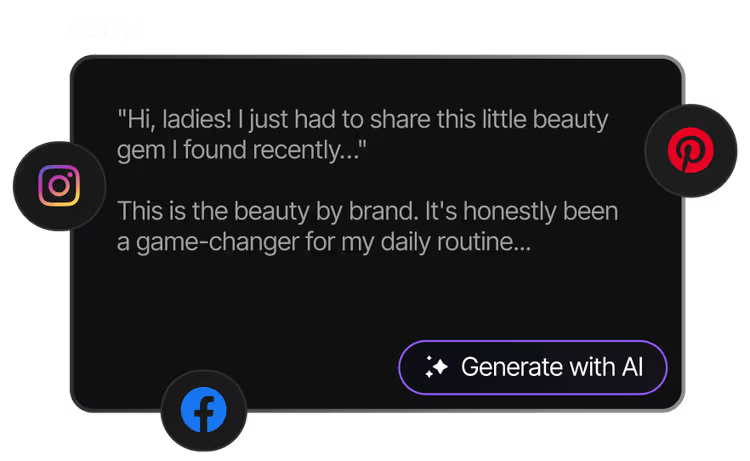
Here’s what took me too long to learn. Scripting for an AI UGC ad is not the same job as briefing a human creator. When you brief a person, you can write “sound excited here” and trust them to figure it out. An AI avatar does exactly what your script and your settings tell it to, no more and no less.
That is a superpower once you understand it, because it means a great script produces a great video every single time, with no flaky creators and no reshoots. It also means a lazy script produces a robotic, obviously-AI video that gets scrolled past in half a second.
This guide is the process I use now. You will get the anatomy of a converting script, the frameworks that actually work, a hook swipe file organized by the psychology behind each one, three complete example scripts you can adapt today, and the AI-specific rules that most articles on this topic quietly skip. By the end you will be able to write a script in about ten minutes that an AI tool can turn into an ad worth running.
Why Scripting for AI Is Different From Briefing a Human Creator
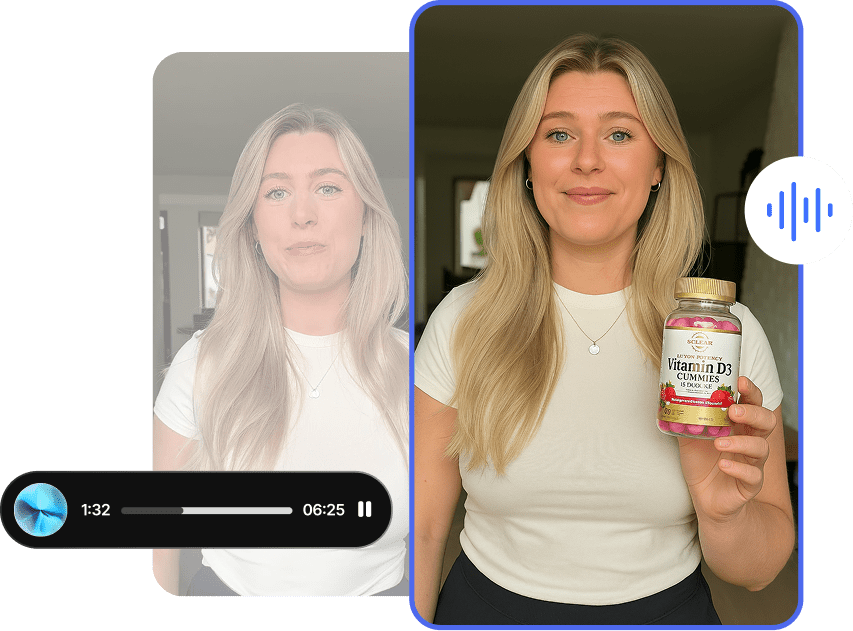
Start here, because this is the part almost every other guide gets wrong. They hand you the same advice you would give a human creator and call it a day. But an AI avatar reads your script through a voice engine and performs it literally, so a few specific rules change everything.
Write for the ear, not the page.
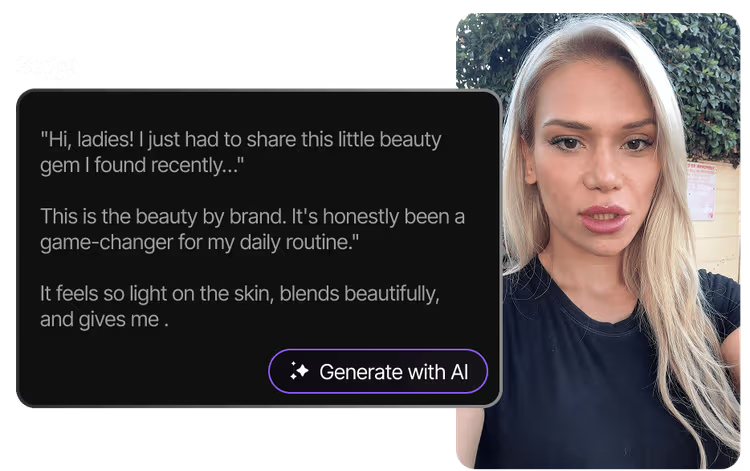
The voice engine speaks exactly what you type. Read every line out loud before you use it. If you stumble, the AI will too. Short, spoken-language sentences beat clever written ones every time.
Use punctuation as your director.
Commas create small pauses, periods create full stops, and that is how you control pacing. A line with no punctuation gets rushed. Break your sentences where you want the avatar to breathe.
Avoid tongue-twisters and hard number strings.
Phrases packed with repeated consonants, or long strings of digits and symbols, trip up voice engines and produce that flat, mangled read that screams AI. Spell tricky words the way they sound if you have to.
Match the script to the avatar.
A twenty-two-year-old avatar in a bedroom setting cannot deliver a line written for a fortysomething finance executive, and the mismatch is instantly obvious. Pick your avatar first, then write in that person’s voice, age, and energy.
Make the hook spoken, not just captioned.
A lot of creators put the clever hook only in the on-screen text and let the avatar open with “Hey guys.” That wastes your best asset. The spoken first line and the on-screen text should both carry the hook, because sound-on viewers and silent scrollers are two different audiences and you need both.
Keep sentences lip-sync friendly.
Very long sentences drift out of sync and expose the avatar as artificial. One idea per line keeps the mouth movement believable and the message clear.
Get these right and the AI looks natural. Ignore them and no avatar, however realistic, will save the ad.
The Anatomy of a Converting UGC Ad Script
Every high-performing UGC ad, human or AI, follows the same skeleton. Learn it once and you can write endlessly.
Length: aim for 15 to 30 seconds. That is roughly 40 to 80 spoken words. Long enough to make one clear point with proof, short enough that people watch to the end, which is the signal and platform reward.
The five beats:
- Hook (0 to 3 seconds): stop the scroll and make one promise.
- Problem (3 to 8 seconds): name the specific pain your viewer feels.
- Solution (8 to 18 seconds): introduce the product as the fix, and show it.
- Proof (18 to 25 seconds): give a reason to believe, a result, a demo, a detail.
- Call to action (final 3 to 5 seconds): tell them exactly what to do next.
The three-second hook is three channels firing at once
This is the piece that separates good scripts from great ones, and it matters double for AI UGC because you control all three channels precisely.
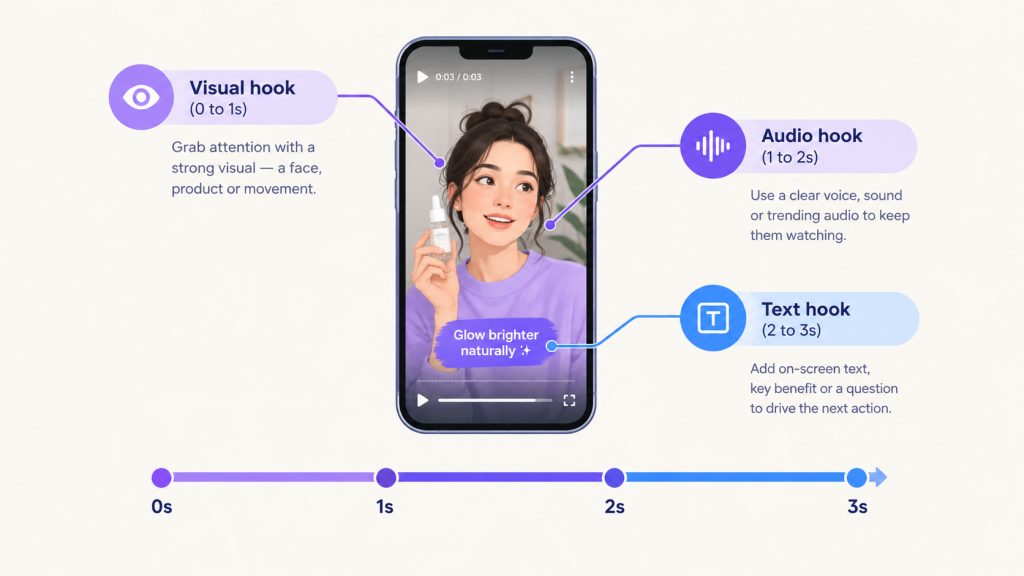
- Second 0 to 1, the visual hook: what they see the instant the video loads. An extreme close-up, a surprising action, the product doing something, a pattern interrupt. This alone stops a silent scroll.
- Second 1 to 2, the audio hook: the first spoken line, conversational and specific, landing on a real pain or promise.
- Second 2 to 3, the text hook: a bold on-screen caption for the majority who scroll with the sound off.
When all three align on the same promise, you catch every kind of viewer at once. When they fight each other, or when two of the three are missing, you lose. Most weak AI UGC ads have only the audio channel working, with generic visuals and no caption. Fix that and your hold rate climbs before you change a single word of the offer.
The Three Script Frameworks That Actually Work
You do not need twenty templates. You need three frameworks and the judgment to pick the right one for how aware your audience is.
PAS: Problem, Agitate, Solution. Best for cold audiences who feel a pain but have not gone looking for a fix. You name the problem, twist the knife a little so they feel it, then present the product as relief.
Skeleton: “If you [problem], you know how [agitation]. Here is what finally fixed it for me.”
AIDA: Attention, Interest, Desire, Action. Best for a broad top-of-funnel push where you are introducing something new. Grab attention, build interest with a benefit, create desire with proof, then ask for action.
Skeleton: “[Attention hook]. Here is why it matters. Here is what it did for me. Here is how to get it.”
Hook, Problem, Solution, Proof, CTA. The workhorse. Best for warmer audiences and product-led ads where the proof does the heavy lifting. It is the five-beat anatomy above, used as a fill-in-the-blank.
Skeleton: “[Hook]. The problem was [pain]. Then I found [product]. Now [result]. [CTA].”
A rule of thumb from experienced media buyers: match the hook to buyer awareness. A problem-aware viewer wants you to name their pain. An unaware viewer needs a pattern interrupt or a bold claim first. A solution-aware viewer wants proof and a reason to pick you over the alternative.
Hooks That Convert: The Swipe File
Here is a swipe file you can steal, organized by the psychology behind each hook rather than by surface style, because understanding why a hook works is what lets you write your own. Each comes with a fill-in-the-blank and a plain example. Swap in your product and audience.
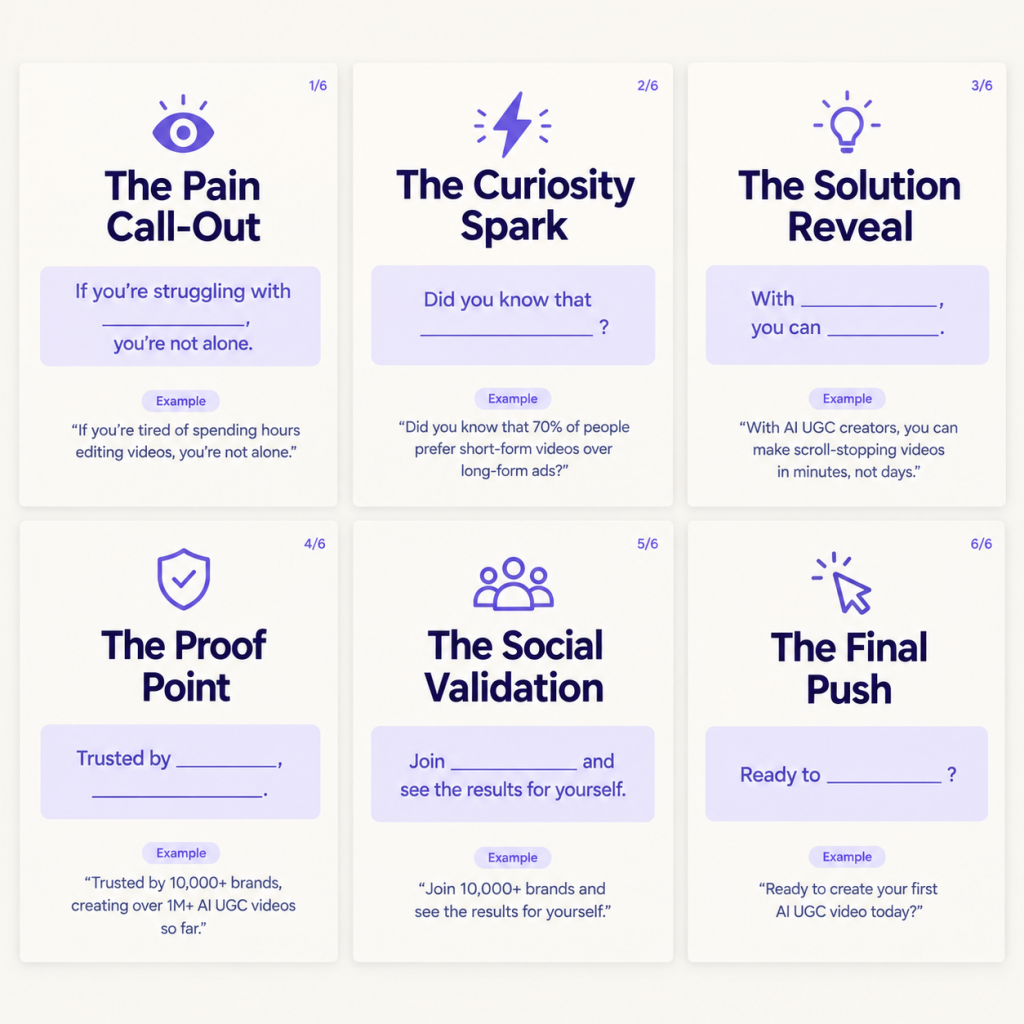
1. The pain call-out. Names the exact problem in the first two seconds so the right person stops.
“Struggling with [specific problem]? Do this.” Example: “Struggling to fall asleep even when you are exhausted? Watch this.”
2. The identity call-out. Speaks to a specific person so they feel seen and everyone else scrolls on, which is a feature, not a bug.
“If you are a [identity], you need to see this.” Example: “If you work from home and your back is wrecked by 3pm, this is for you.”
3. The confession. An honest, slightly vulnerable admission that reads as real, not advertised.
“I almost returned this until [turning point].” Example: “I almost returned this serum after week one. Then week three happened.”
4. Proof-first, the tester. You did the work so they do not have to, which builds instant trust.
“I tried [thing] for [time] so you do not have to. Here is the truth.” Example: “I used this for 30 days straight. Here is the honest result.”
5. The bold specific claim. A concrete, surprising number or outcome beats a vague superlative.
“This [product] did [specific result] in [timeframe].” Example: “This cut my editing time from two hours to twenty minutes.”
6. The contrarian. Challenges a common belief, which creates a small jolt of “wait, what?”
“Everyone says [common advice]. That is exactly why [problem].” Example: “Everyone says drink more water for your skin. That is why yours is still dry.”
7. The curiosity gap, used carefully. Withholds the answer to pull people in. Powerful, but the pro warning applies: a vague curiosity hook attracts the wrong crowd and tanks conversions, so tie the curiosity to your actual buyer.
“Nobody tells you this about [topic].” Example: “Nobody tells you why your protein coffee tastes chalky. It is one thing.”
8. The before and after. Shows transformation in the first frame, which is pure visual proof.
“This was my [before]. This is now.” Example: “This was my desk two weeks ago. This is it today.”
9. The objection flip. Names the doubt out loud and answers it, which disarms skeptics.
“You think [objection]. Here is why that is wrong.” Example: “You think all these gadgets are gimmicks. So did I.”
10. The pattern interrupt. A visual or verbal surprise that has nothing to do with a typical ad open, then a fast bridge to the point.
“[Unexpected action or statement], and here is what it has to do with [product].”
One rule ties them all together, straight from people running real budgets: the hook earns the click, but it does not earn the sale. Its job is to stop the right person and hand them off to a body and offer strong enough to close. Write the hook to pre-qualify, not just to grab.
Formats That Convert, and When to Use Each
Formats are the container your framework lives in. Here are the ones that consistently perform, with a one-line note on when to reach for each.
- Testimonial: a satisfied customer sharing a result. Best when you have a strong, specific outcome to feature. Warm and mid-funnel.
- Problem to solution: the classic. Best for cold audiences with an obvious pain. Pairs with PAS.
- Unboxing or first impression: live reaction to receiving and trying the product. Best for physical products where the reveal is satisfying.
- Before and after: transformation over time. Best for skincare, fitness, organization, anything visual.
- Three reasons or three things: a fast, listicle-style rundown. Best for holding attention with quick cuts and for products with several selling points.
- I tried it so you do not have to: the guinea-pig angle. Best for building trust with skeptical, research-heavy buyers.
- Founder story: why the product exists. Best for brand-building and for premium or mission-led products.
- The skeptic: starts doubtful, ends convinced. Best for crowded categories where people assume everything is hype.
- Day in the life: the product woven into a real routine. Best for lifestyle products and soft-sell brand awareness.
- Tutorial or how-to: teaches something useful with the product inside it. Best for products that need a quick demo to click.
You do not need all ten. Pick two or three that fit your product and test them against each other.
Three Complete Example Scripts You Can Copy
Templates are useful, but nothing teaches like a finished script. Here are three, written the way I would actually hand them to an AI UGC tool, with timestamps and all three hook channels spelled out. Products are generic on purpose so you can swap yours in.
Example 1: Skincare serum (Problem to Solution, PAS framework, ~25 seconds)
0 to 3s, Hook Visual: extreme close-up of skin, then the avatar holding the bottle. On-screen text: “week 3 with this changed my skin” Spoken: “I almost returned this serum after the first week. I am so glad I did not.”
3 to 8s, Problem Spoken: “My skin was dry and flaky no matter how much water I drank or how much moisturizer I piled on.”
8 to 18s, Solution Visual: applying two drops, then a morning routine shot. Spoken: “Two drops of this every morning. That is it. It is a lightweight hydrating serum, so it actually absorbs instead of sitting on top.”
18 to 22s, Proof Visual: side-by-side of week 1 and week 3. Spoken: “By week three the flaking was gone and my makeup finally sat right.”
22 to 25s, CTA On-screen text: “link in bio, 20% off today” Spoken: “Grab it from the link before the discount ends.”
Example 2: Focus and productivity app (Identity hook, AIDA framework, ~22 seconds)
0 to 3s, Hook Visual: avatar at a messy desk with ten browser tabs open. On-screen text: “if you can’t focus for more than 10 minutes” Spoken: “If you open your laptop to do one thing and lose an hour, this is for you.”
3 to 9s, Interest Spoken: “I thought I had a discipline problem. Turns out I had a too-many-tabs problem.”
9 to 17s, Desire Visual: the app blocking distractions, a clean single-task screen. Spoken: “This app hides everything except the one thing you are working on and runs a simple timer. My focus sessions went from a mess to actually finishing things.”
17 to 22s, Action On-screen text: “free for 7 days” Spoken: “It is free to try for a week. Link is right here.”
Example 3: Meal-prep delivery (Three things format, Hook-Problem-Solution-Proof-CTA, ~28 seconds)
0 to 3s, Hook Visual: opening a fridge stacked with labeled meals. On-screen text: “3 reasons I stopped cooking dinner” Spoken: “Three reasons I stopped cooking dinner and do not miss it at all.”
3 to 8s, Problem Spoken: “One, I was spending an hour every night cooking and cleaning after a full workday.”
8 to 20s, Solution and Proof Visual: heating a meal, eating it, checking the app. Spoken: “Two, these arrive already made, so dinner takes three minutes. Three, they actually taste like real food, not sad diet trays. I have eaten them for a month and I am still not bored.”
20 to 28s, CTA On-screen text: “first box 50% off” Spoken: “If your evenings feel too short, try a box. First one is half off with the link below.”
Notice what these share: the hook lands on all three channels, the spoken lines are short and easy to read aloud, each script makes one point with one proof, and the CTA is a single clear action. That is the whole game.
Write Your Script in 10 Minutes: The Process
Here is the repeatable process. Set a timer.
- Pick the awareness level (1 minute). Is your viewer unaware, problem-aware, or solution-aware? This decides your hook type and framework.
- Choose a format and framework (1 minute). Match them to the product and awareness level. Problem to solution with PAS for cold pain, three things with the workhorse structure for feature-rich products, and so on.
- Write five hooks, not one (3 minutes). Pull from the swipe file. You will test these, so quantity matters here.
- Draft the body in one pass (3 minutes). Fill the beats: problem, solution, proof. Keep every line to one idea.
- Write one clear CTA (30 seconds). One action. “Tap the link,” “get 20% off today,” not a menu of options.
- Read it out loud and cut (1 minute 30 seconds). If you stumble, rewrite the line. If it runs past 30 seconds, cut words. Shorter almost always wins.
Then generate the video, keep the body and offer fixed, and swap in your five different hooks to see which opening wins.
Scripting Mistakes That Kill AI UGC Ads
Avoid these and you are ahead of most advertisers.
- The hook lives only in the caption. The avatar opens with “Hey guys” while the clever line sits in text. Put the hook in the spoken line too.
- Writing lines a voice engine cannot say naturally. Long, comma-free sentences and tongue-twisters produce the robotic read. Read everything aloud first.
- Avatar and script mismatch. A corporate script in a Gen-Z bedroom setting, or the reverse. Pick the avatar, then write for that person.
- Too long. Past 30 seconds you lose the people who would have converted. Make one point well.
- Too salesy, too soon. Opening like a commercial breaks the UGC illusion. It should sound like a person talking to a friend.
- Curiosity bait that misfires. A vague mysterious hook pulls in the wrong viewers who never buy. Tie curiosity to your actual buyer.
- No real CTA, or five of them. Confused viewers do nothing. End with one clear action.
How to Test Hooks the Right Way
Scripting is half the job. Testing tells you which script was right, and the method matters.
Isolate the hook. Keep the body, proof, and offer identical, then run three to five different openings. Whatever wins, you learned something clean, because only one variable changed. This is the single highest-impact test in paid ads, and AI UGC makes it nearly free since generating five hook variants costs minutes, not a reshoot.
Watch the right metrics. Hook rate and hold rate tell you if the opening is working. But do not stop there, because experienced buyers will tell you that hook rate does not always correlate with sales. Follow it through to click-through rate, cost per click, and cost per acquisition. A hook that stops scrolls but does not sell is attracting the wrong people.
Expect a kill rate. Most variations will lose, and that is the point. The goal is not a perfect first script, it is finding the winner fast and cheaply, then scaling it. Budget for testing many so you can pour spend into the few that work.
What Marketers Are Actually Saying on Reddit
I pressure-tested all of this against what media buyers say to each other, and the nuance they add is worth more than any template.
The strongest theme is that the hook is necessary but not sufficient. As one marketer put it, the hook decides whether you get a chance; it doesn’t decide whether you get a sale. You can have a great opening and still fail if the offer, proof, or angle is weak. Another framed it cleanly: the hook earns attention, the body builds desire, the offer closes. The old David Ogilvy line still gets quoted in these threads: if the headline fails, most of your ad budget is wasted, and in video, the headline is your hook.
The sharpest insight is about pre-qualification. A vague curiosity hook can get cheap clicks and low intent, because you are attracting the wrong audience. The fix that buyers recommend is to put the problem or the audience right in the first two seconds, so you stop the right scroll and not just any scroll. One buyer who scaled an account from 100,000 to 200,000 dollars in monthly spend went further, arguing that hook rate alone has little direct correlation with performance, and that what matters is how the whole piece flows from hook to CTA. In other words, the script is a unit, not a hook with filler attached.
On using AI to write, the consensus is practical: use AI for structure, the PAS and AIDA scaffolding, then write or rewrite the actual lines yourself, because AI often misses the specific customer language and pain points that make copy land. That is exactly the right way to use an AI script writer, as a fast first draft you humanize, not a final answer.
How Tagshop AI Fits Into This Workflow
How Tagshop AI’s Video Agent Builds the Ad For You
Here is what makes this whole method easy to actually run: you do not have to become a prompt engineer to use it. Tagshop AI’s AI Video Agent is built to take a plain, human description of what you want and handle the hard parts for you.
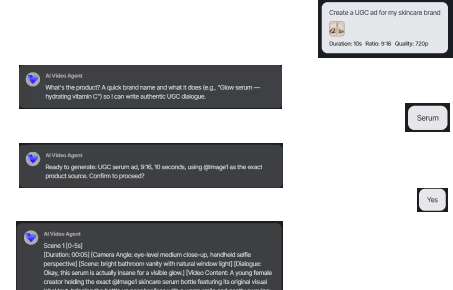
You skip the long, detailed prompt entirely. You tell the agent what you are selling and roughly who it is for, in normal language, and it takes the wheel from there. Instead of forcing you to specify everything perfectly in one shot, the agent asks you smart follow-up questions, the same ones a good creative strategist would ask. Who is this really for. What problem does it solve? What tone fits your brand? What is the one action you want a viewer to take. Every answer sharpens the direction, so what comes back is shaped around your product and your customer, not a generic template.
From those answers, the agent builds the storyboard for you. It lays out the hook, the beats, the on-screen text, and the shots using the same structure this guide walks through, then turns that storyboard into a finished video. You never stare at a blank timeline or dig through settings. You are reviewing a draft that already understands what you asked for, then nudging it until it is right.
That is what changes the economics of everything above. Because the agent carries the script-to-render step, a small team can produce dozens of on-brand variants a week. Paste a product URL and it pulls the details and drafts the script and the video with no blank page in sight. Find a winner, and Ad Clone spins fresh variations off it so you keep testing new hooks on a proven body. Generating another variant takes minutes, which is exactly what turns the isolate-the-hook testing method from a nice idea into your default habit.
The agent doesn’t replace the thinking in this guide, and it shouldn’t. It removes the friction between the idea in your head and the video on the screen, so the part that actually decides performance- your hook and your angle- is the part you spend your time on.
Key Takeaways
- The script decides the ad, not the avatar. Avatar quality has flattened, so your words and your hook are the edge.
- Scripting for AI is its own skill. Write for the voice engine, keep lines short and speakable, match the script to the avatar, and make the hook spoken as well as captioned.
- The hook is three channels at once: visual, audio, and text, all landing on the same promise in three seconds.
- Use one of three frameworks, PAS, AIDA, or Hook-Problem-Solution-Proof-CTA, chosen by how aware your audience is.
- Hooks earn attention, structure and offer earn the sale. Write hooks that pre-qualify the right viewer, not vague curiosity that attracts the wrong one.
- Keep it to 15 to 30 seconds and one clear CTA.
- Test the hook as an isolated variable, same body and offer, three to five openings, and follow the metrics past hook rate to actual conversions.
Final Word
The best AI UGC tool in the world will not save a weak script, and the plainest tool will shine with a strong one. So put your energy where the results actually come from: a hook that stops the right person on three channels at once, a tight structure that carries them to a believable proof, and one clear thing to do next. Write five hooks, not one, test them on the same body, and let the data pick the winner. Do that on repeat, and you will not be guessing anymore. You will be compounding.
Frequently Asked Questions
Aim for 15 to 30 seconds, which is roughly 40 to 80 spoken words. That is long enough to make one point with proof and short enough that people watch to the end, which is the behavior ad platforms reward.
Hook, problem, solution, proof, and one clear call to action. For cold audiences, the PAS framework (Problem, Agitate, Solution) works well. For broad awareness pushes, AIDA (Attention, Interest, Desire, Action) fits better.
A good hook fires on three channels in the first three seconds: a visual interrupt, a spoken opening line, and bold on-screen text, all pointing at the same promise. It should name a specific pain or audience so it pre-qualifies the right viewer rather than baiting anyone.
You are writing for a voice engine and a literal performer. Keep sentences short and easy to say aloud, use punctuation to control pacing, avoid tongue-twisters, match the script to the avatar’s age and persona, and make sure the hook is spoken, not just shown as text.
Write and test three to five hooks on the same body and offer. Change only the opening so the result is clean. AI UGC tools make this cheap, since generating another variant takes minutes.
Use AI for the structure and a fast first draft, then rewrite the lines in your customer’s real language. Media buyers consistently say AI nails the framework but misses the specific slang and pain points that make copy convert.
Both reward completion, so keep it tight. Many buyers find 15 to 30 seconds is the sweet spot for direct-response UGC on both, with some testing longer top-of-funnel storytelling ads to build watch time and warm the audience.
Written by:

Kashish Vaswani is a Content Strategist at Tagshop AI, specializing in AI-powered marketing, UGC advertising, and eCommerce content. She creates actionable guides, industry insights, and product-focused resources that help brands, marketers, and creators leverage AI to produce high-converting video ads and scale their content strategy with confidence.
 Add Tagshop.ai as a preferred source in Google Search




 Introducing

 Wan 3.0 is now live on Tagshop AI