AI UGC for Fashion & Apparel E-Commerce: The Future of Product Marketing
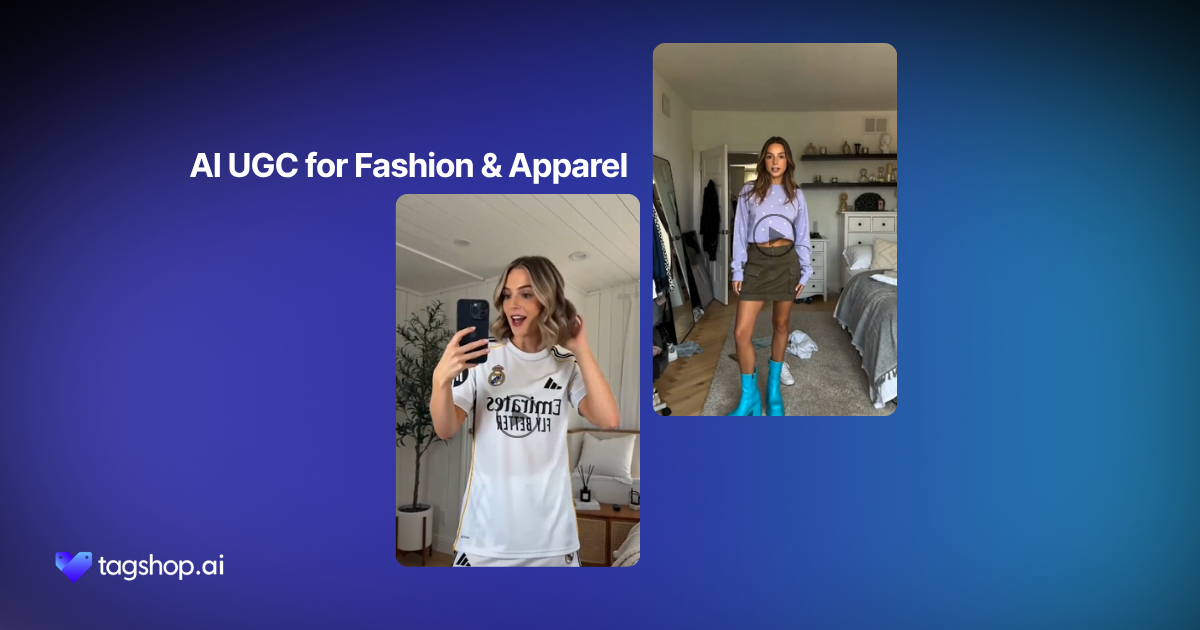







People trust what they can see move.
Before you buy the dress, you probably open Instagram or TikTok too. To look for someone who’s actually worn it, a real body, telling you straight whether it’s worth it.
When you find it, you buy with confidence. When you don’t, the doubt that was already sitting there- will this really look like the photo? And it only gets louder on the way to checkout.
That’s not you being paranoid. That’s you doing what an entire generation has quietly agreed on without ever saying it out loud: the product page is a claim, real footage is proof, and you’ll go find the proof yourself.
It’s the same instinct behind bracketing. Ordering two or three sizes with a plan to return whatever doesn’t work, because no page ever gave you enough proof to commit to just one. Recent data puts bracketing at up to 63% of online shoppers. A standard retail return sits around 8%.
Online fashion and apparel blows past that, routinely landing between 24% and 30%. Each of those returns runs a brand somewhere between $10 and $20 to process. Do that math on a cart with two extra sizes sitting in it, and the margin’s gone before the box even leaves the warehouse.
Real creators filming try-on hauls used to be the proof shoppers sought. One person, on camera, telling you straight how something actually fit. It worked right up until brands needed that proof for every size, every drop, every platform, faster than any creator roster could keep up with.
AI UGC for fashion picked up exactly where real creators hit their ceiling: the same believable proof, minus the part where you’re waiting on someone’s schedule to get it.
What Is AI UGC for Fashion & Apparel?
AI UGC for apparel is a video built around a generated presenter model, avatar, whatever you want to call it. Try-on hauls, get-ready-with-me clips, an honest read on how a fabric holds up after a wash. The delivery looks identical to the real thing. The person delivering it was generated rather than booked.
It’s not the same as an AI product photo. A photo shows you a shirt sitting still. AI-generated UGC for apparel shows you what happens when an actual arm reaches through a sleeve which, if you’ve ever bought a top that looked perfect until you tried to raise your arms in it, is the only footage that actually tells you anything.
Why Fashion Brands Need AI UGC
Fashion has three problems that are specific to the category, and they stack on top of each other.
- Fit doesn’t show up until the box does. A shopper can read “true to size” a hundred times and still get blindsided the second they open the package. Nothing on the product page warned them. Video is the only format that captures this before the return, not after.
- The white-background photo stopped working. Honestly, it looks like every other ad in the feed. Shoppers have gotten very good at scrolling past anything lit like a passport photo.
- One shoot was never going to cover it. Four body types, three platforms, a dozen seasonal angles, for a single SKU. Booking that many real creators isn’t a line item in the budget. It’s a calendar that doesn’t exist.
This same pressure is reshaping AI UGC for e-commerce broadly, just louder in fashion, where “will this actually fit me” has never once been answered by a paragraph of copy.
AI UGC doesn’t hand anyone better taste. It just removes “we didn’t have time to test that angle” as a real excuse.
Benefits
- Shows fit, not just fabric: “stretchy” printed on a tag means nothing until someone sits down in it on camera, and that one moment answers a question the size chart never could.
- Covers more bodies without booking more shoots: the industry’s decades-overdue attempt at showing more than one body type finally has no scheduling excuse left, because it’s the same generation step, not a separate production.
- Turns a Friday drop around by Friday, not “we’ll get to it next month”, the gap between a shoot calendar and a same-day render.
- Tests five hooks for the cost of pretending to test one: styling angle, fit angle, fabric angle and you find out which one actually stops a thumb, instead of guessing and hoping your one video covers everyone.
- Feels native to the feed it’s running in: nobody’s scrolling TikTok hoping for better studio lighting, and the platforms already reward exactly this look over anything that reads as produced.
Why Volume Actually Works: Creative Velocity
AI UGC is all about creative velocity: how fast you can get enough distinct video variations in front of an ad platform for its targeting to actually do its job.
TikTok and Meta don’t serve an ad to “your audience.” They serve creative to whichever specific viewer responds to it, and they can only figure that out with more than one option to test. A brand running a single studio video only ever reaches the one type of buyer that video happens to land with.
Ten AI UGC variations, one fit-focused, one fabric-focused, one styling-focused hand the algorithm enough raw material to match the right video to the right person, instead of hoping one video works for everyone.
That’s the actual case for volume. Not “more content.” More shots at finding out who’s watching.
Types of AI UGC in Fashion
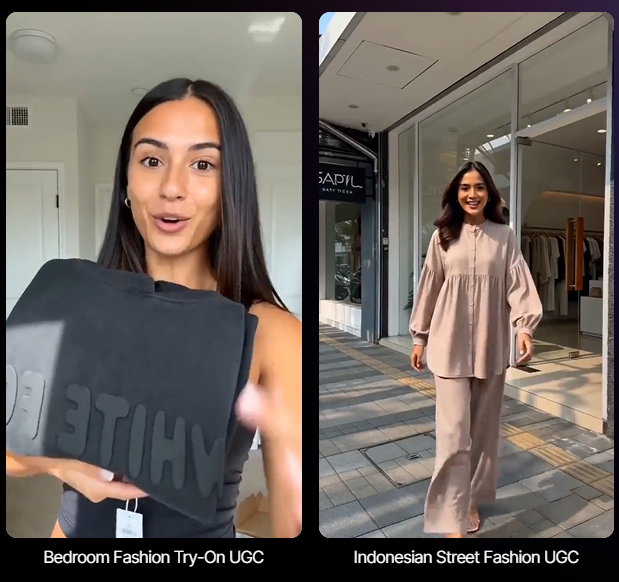
- Try-on hauls – three or four pieces, reactions in real time, the “wait, this actually fits” moment left in. Works best short, 15 to 30 seconds, one cut per item, not a highlight reel.
- Styling and outfit-pairing – the same piece, two completely different nights out. The fastest way to show one SKU covers more occasions than the product photo ever implied.
- Fabric and fit testimonials – the unglamorous stuff that actually sells: “doesn’t pill,” “waistband doesn’t dig in by hour six.” These hold up better as one continuous take than a cut-heavy edit — less cutting reads as more honest.
- Size-inclusive demos – the same dress on different bodies, side by side or back to back, no separate campaign or extra shoot required to make it happen.
- Unboxing clips – the five seconds before anyone’s even tried it on, which somehow still gets watched all the way through. Strong for hype around a new drop, weaker for fit-heavy categories like denim where the try-on is the whole point.
- Honest comparisons – this piece next to the one they’re also considering, styled and shot the same way, no thumb on the scale.
How to Make AI UGC for Fashion Products
Here’s what that actually looks like inside Tagshop AI.
Step 1: Input Everything.
Head to your dashboard. The AI Video Agent is right there on the home page. Type your idea in plain language, something like “Show this dress styled for a summer wedding guest look.” Add your product next: paste a URL, and Tagshop AI pulls the description and images automatically, or fill it in manually if you don’t have a link. Then set your format: aspect ratio, resolution, and length, anywhere from 4 seconds up to a full 60. The Agent defaults to the newest model automatically, but you can switch it yourself.
Step 2: Answer the Questions
The Agent comes back with follow-up questions about your audience, tone, and messaging, who’s actually buying this piece, and what tone fits your brand. Answer it like you’re briefing a teammate, not filling out a form.
Step 3. Review, Generate, and Download:
The Agent builds a scene-by-scene storyboard for you to review. If something’s off, say so plainly: “make the styling shot come first” or “show the fabric texture closer up,” and it fixes just that part. Once it looks right, hit Generate, download, and publish to TikTok, Reels, or Shorts.
7 Ready-to-Use Prompts for Fashion & Apparel
Steal these AI prompts directly, swap in your product, and adjust the details:
- “Show this [item] on someone getting ready for a first day at a new job – casual, a little nervous energy, checking the fit in the mirror.”
- “Create a try-on haul: three tops from the same collection, quick honest reactions to fit and fabric on each.”
- “Style this [dress or piece] two ways: one for daytime, one for a night out, same item.”
- “Show a fabric close-up first – texture, stretch, how it moves – before cutting to the full outfit.”
- “A testimonial-style clip: someone talking about how this [item] fit differently than they expected, in a good way.”
- “Show this piece across three different body types, same size, so shoppers can see how it actually sits.”
- “An unboxing-style video: opening the package, first reaction, then trying it on.”
Must Explore: Apparel Video Templates
What People Are Saying on Reddit
The same three questions show up in almost every marketing and e-commerce thread, regardless of which tool or brand started the conversation: can shoppers actually tell it’s AI, does it need a disclosure label, and does it hold up for anything above mass-market where “feels like a real person” carries more weight.
Nobody’s fully settled on the disclosure question yet, and that’s the honest answer, not a dodge. The closest thing to a consensus is that AI UGC works best sitting next to real customer content, not standing in for it, and that brands being upfront about what it is tend to get less pushback than the ones hoping nobody notices.
The skepticism about whether people can tell isn’t unfair, either; it’s usually earned. A lot of early AI marketing video felt off for one reason: everything came out too perfect. No hesitation, no bad angle, no awkward pause, and viewers have gotten good at clocking that as fake, precisely because that’s not how real people talk on camera.
The fix isn’t a better render. It’s building the small imperfections back in on purpose, a stumble, a slightly off angle, lighting that reads like a bedroom instead of a ring light, so what comes out looks unscripted instead of generated.
Expert Take
From Tagshop AI’s own creative team: fashion might be the single category where AI UGC has the clearest job to do, because the thing shoppers actually need, proof of fit and movement, is exactly what a still photo has never been able to give them. At the end, fashion brands that keep up fast are the ones that answer before the shopper has to ask.
Where This Actually Pays Off
- Paid social managers running daily creative refreshes get new hooks to feed the algorithm without booking a new creator every week.
- DTC brands without a studio budget get a product video that looks native to the platform, minus the line-item for a photographer, a model, and a rented space.
- Sizing and fit teams trying to cut returns get a format that actually answers “will this fit me” before the box ships, instead of after it comes back.
- Brands running fast seasonal drops get turnaround measured in hours, not the multi-week lead time a real shoot requires.
- Teams testing a new market or demographic get the same product styled for a completely different buyer, without having to fly out a new creator for each audience.
Must Explore: AI Video Templates for Accessories Brands
Conclusion
The two-sizes-in-one-cart habit doesn’t go away because of better lighting. It goes away when a shopper can actually see the fit before they hit buy, which is the one thing video does that a still photo never will. That’s the entire case for AI UGC in fashion. Not cheaper content. Fewer boxes are coming back.
Frequently Asked Questions
No. It uses generated avatars or presenters built for marketing, not the likeness of a real, identifiable person used without consent.
Requirements vary by platform and region, and they’re getting stricter, not looser. Check current ad policies before you publish, and when you’re not sure, disclose.
Less and less, especially with small imperfections left in on purpose: a stumble, a re-take, lighting that isn’t perfectly even. Those are what make it read as unscripted instead of studio-shot.
It can, but the bar goes up. Premium buyers notice the one thing that feels slightly off faster than anyone, so these usually need an extra refinement pass or two before they’re ready.
No, and it shouldn’t try to. A real creator brings an audience and a kind of credibility AI can’t fake. AI UGC earns its keep covering what real creators physically can’t: every size, every SKU, every platform, every week.
It won’t erase them. But showing fit and movement on video instead of a still photo closes some of the distance between what a shopper expects in the box and what they actually get.
Minutes, once you know what you’re trying to say. The tool is fast. A vague brief is still a vague brief, no matter how quickly it gets turned into video.
Written by:

Kashish Vaswani is a Content Strategist at Tagshop AI, specializing in AI-powered marketing, UGC advertising, and eCommerce content. She creates actionable guides, industry insights, and product-focused resources that help brands, marketers, and creators leverage AI to produce high-converting video ads and scale their content strategy with confidence.
 Add Tagshop.ai as a preferred source in Google Search

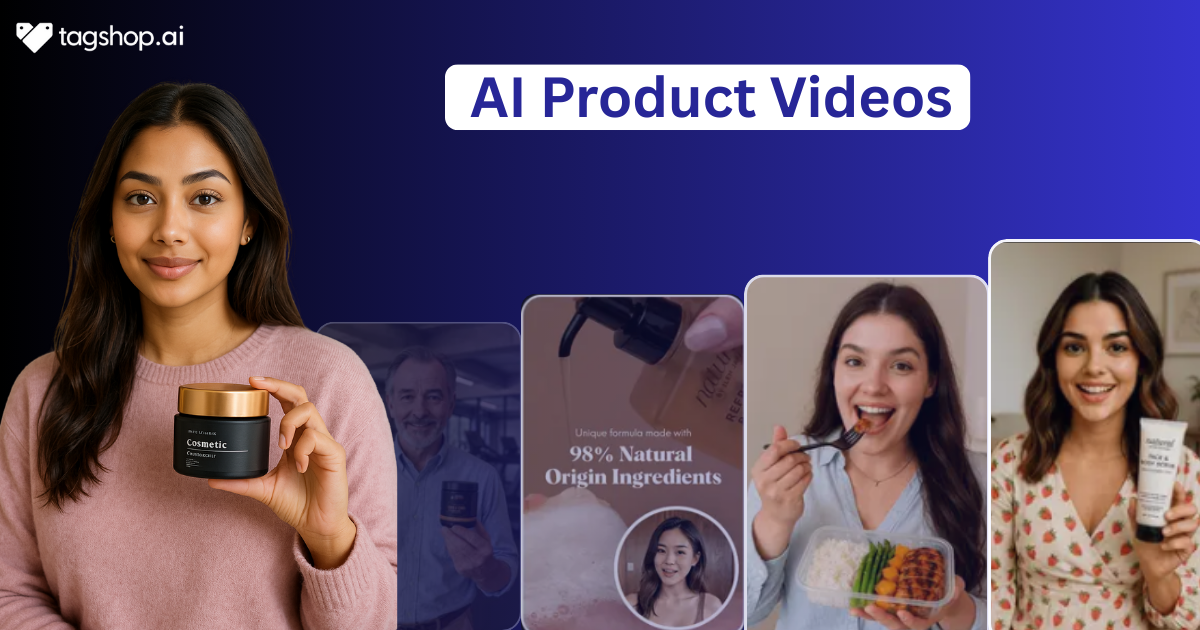





 Introducing

 Wan 3.0 is now live on Tagshop AI