How to Make AI UGC for Agencies: A Complete Step-by-Step Guide








I spend a good chunk of my week inside demo calls and follow-up threads for Tagshop AI, and agencies are the ones who ask the sharpest questions on those calls. Not “does the AI look real,” they’ve usually already decided that part is fine. What they actually want to know is whether this holds up across fifteen different client accounts without turning into a mess. That’s a different question than the one most content on this topic answers, so that’s the one I wanted to actually address here.
TL;DR: Most content on AI UGC talks about one brand, one product, one campaign. Agencies don’t have that problem. They have five, fifteen, or fifty client accounts, each needing fresh creative every 2 to 4 weeks before it fatigues, each with a different brand voice, and usually the same small creative team covering all of it.
That’s not a creative-quality problem; it’s a math problem, and it’s the actual reason agencies are adopting AI UGC faster than individual brands. This post covers the math, a real named case study (PPC agency WhiteDigital, $120K saved per quarter, 4.2x ROI), and the operational stuff nobody else covers: how to keep every client’s brand voice distinct, and the two separate disclosure conversations agencies actually need to have.
The Problem Isn’t Creative Quality. It’s Creative Math.
Here’s the number that should worry every agency owner: creative fatigues fast. Roughly half of all ad creatives get turned off before 28 days, and only 4 to 8% of everything produced ever qualifies as an actual “winner.” Ad fatigue itself drives a 35% CTR decrease and a 20% CPC increase once an audience has seen the same creative too many times.

Now multiply that by client count. If one brand needs 10 to 15 fresh variants a month just to keep testing alive, an agency running 10 client accounts needs 100 to 150 a month, across different brand voices, different platforms, different audiences. A traditional creative team, even a good one, physically cannot produce that volume with shoots, scripts, and edits done by hand. This is why agencies feel the AI UGC shift more urgently than individual brands do: the volume problem isn’t linear, it’s multiplied by every single account on the roster.
Why Clients Actually Fire Agencies (It’s Rarely the Work)
If you’re an agency owner, this stat matters more than any creative-quality metric: 39% of clients leave because they’re unhappy with strategy and thinking, not execution quality, and close to 40% of businesses say they’re actively planning to switch agencies over poor performance, with a documented “lack of proactivity” showing up as a named reason nearly a third of the time. Project-based agencies see 28% client departure within just the first six months.

Put plainly: clients don’t usually leave because one ad wasn’t good enough. They leave because the agency stopped bringing new ideas fast enough, and started feeling reactive instead of proactive. That’s exactly the gap AI UGC closes. It’s not really a “better creative” tool for an agency. It’s a “we can test five new angles before you even ask” tool, and that’s the thing that actually keeps retainers renewed.

What Agencies Actually Learn Once They’re Running This At Scale
Most of what gets written about AI UGC is theory. Instead of adding another opinion to the pile, I reviewed threads from people who’ve run dozens of these campaigns, and the pattern that kept showing up wasn’t flattering to the tool itself; it was about the person using it.
The lesson I kept seeing repeated, in different words, from different accounts: the brief is the whole game. One marketer who’d run 40+ campaigns admitted they treated the brief as a formality at first, a few lines about the product, a rough sense of tone, and got mediocre output for it. The moment they started writing briefs with the same care they’d give an actual human creator, specific tone notes, specific things to avoid, specific proof points, the output changed entirely. I think that’s the single most useful thing I found in all of this research, because it means the tool was never really the bottleneck. The brief was.

The other pattern I noticed, and it changed how I’d tell an agency to structure this: nobody serious is running pure AI end-to-end once an angle wins. The winning format that kept showing up was an AI-generated hook, the first 2 to 3 seconds that stops the scroll, paired with real product footage for the rest. Pure AI works for cheap, fast testing. The hybrid is what people actually scale spend behind.
And on timing, one number kept recurring across completely different accounts: 24 to 48 hours. That’s the window people use to judge whether a variant’s working before cutting it, not a week, not “let’s check at the end of the month.” At agency scale, across multiple clients at once, that’s the difference between running a real testing system and just quietly building a backlog of mediocre content.
Last thing that stuck with me: one creator put it simply, UGC-style ads convert because they don’t look like ads. The lighting’s a little off. The person’s mid-sentence, not mid-pitch. That’s true whether the “person” is real or AI-generated, and it’s exactly why a too-polished AI avatar tends to underperform a slightly rough one. I hadn’t seen that framed so plainly anywhere else.
The Retainer Math Nobody’s Talking About
Here’s the part I think actually changes an agency’s business, not just its output. When creative production cost drops from a few hundred dollars and a few days per asset to a few dollars and a few minutes, the old billing model (charge per finished asset, or a flat monthly retainer that assumes a fixed number of deliverables) stops matching the actual value being delivered. I don’t think enough agencies have sat with that yet.
Two shifts I’ve seen actually working, based on how agencies are restructuring this:
Volume-based testing retainers.
Instead of billing for “4 videos a month,” some agencies are billing for a testing process, a guaranteed number of variants tested per week, with a separate, smaller fee for the handful that get “upgraded” to a polished, human-reshot version once they’ve proven themselves. This directly mirrors the hybrid workflow above: cheap AI testing volume as the base service, human production reserved for confirmed winners.
Reallocating the freed-up hours, not just pocketing them.
The agencies getting the most value aren’t the ones who cut their creative team’s hours. They’re the ones who moved that freed-up time into brief-writing and performance analysis, the two things the Reddit data above says actually determine whether AI UGC works or flops. If the account manager’s time isn’t reinvested into better briefs and faster win/loss calls, the volume increase doesn’t turn into better retention; it just turns into more mediocre content, faster.
The Two Disclosure Questions Every Agency Needs to Answer
This is the part most AI UGC content skips entirely, and it’s specific to agencies in a way it isn’t for in-house brand teams.
Question one: does your client need to know the creative is AI-generated?
Yes, always. An agency producing content on a client’s behalf that the client doesn’t know is AI-generated is a trust problem waiting to surface, especially the first time a client asks “who’s the person in this video.” Be upfront in the deliverable, not defensive about it, most clients care more about performance than production method once they see results.
Question two: does the end consumer need to know?
This depends on the client’s industry, not on the agency. A real estate client showing an AI avatar walkthrough of a real, unaltered listing is on solid ground. A real estate client using AI to alter a property’s actual features without disclosure is not, and that liability sits with whoever approved the final asset. The agency’s job is knowing which of your clients’ industries carry that disclosure obligation (real estate and health-adjacent categories are the two to watch closely) and building it into the workflow by default, not leaving it to each account manager to remember.
What One Agency Actually Did
WhiteDigital, a PPC agency founded in 2002 running a 50+ person team across Meta, Google, and Bing for multiple global brands, adopted Tagshop AI specifically to solve the creator-delay problem across their client roster. The documented results: over 100 ad creative variations generated from a single product image or URL in under 30 minutes, more than $120,000 saved in quarterly creator and studio fees, and a 4.2x increase in ROI on paid campaigns.
Perhaps the most useful data point for agencies specifically: 96% of target consumers couldn’t distinguish the AI-generated clips from human-filmed content, which matters because agency work gets judged by the client’s audience, not by the agency’s own taste.
Inside the Workflow, Run Across Every Client Account
The mechanics are the same three-step Video Agent 2.0 flow covered in earlier posts, idea and product in, follow-ups and storyboard review, generate and post, but the agency-specific discipline is running it as a repeatable system per account, not as a one-off per project:
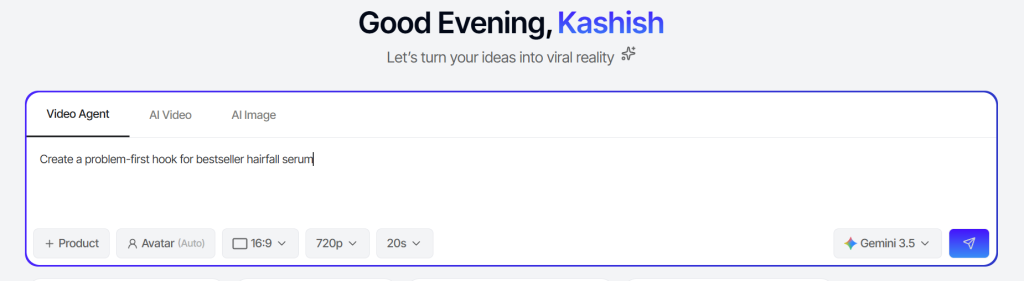
Step 1: Log in to Tagshop AI and Click on Video Agent
Open the Agent and give it the client’s idea, product, and format, using a standing brief instead of re-explaining tone from scratch. Type the plain-language idea (e.g., “create a problem-first hook for [client]’s bestseller”), paste the product URL or upload their asset, and set the format (ratio, resolution, length). The agency-specific move here: keep a standing one-page brief per client (their audience, tone, banned phrases, brand quirks) and pull from it every time you write that idea prompt, so client A never accidentally sounds like client B.
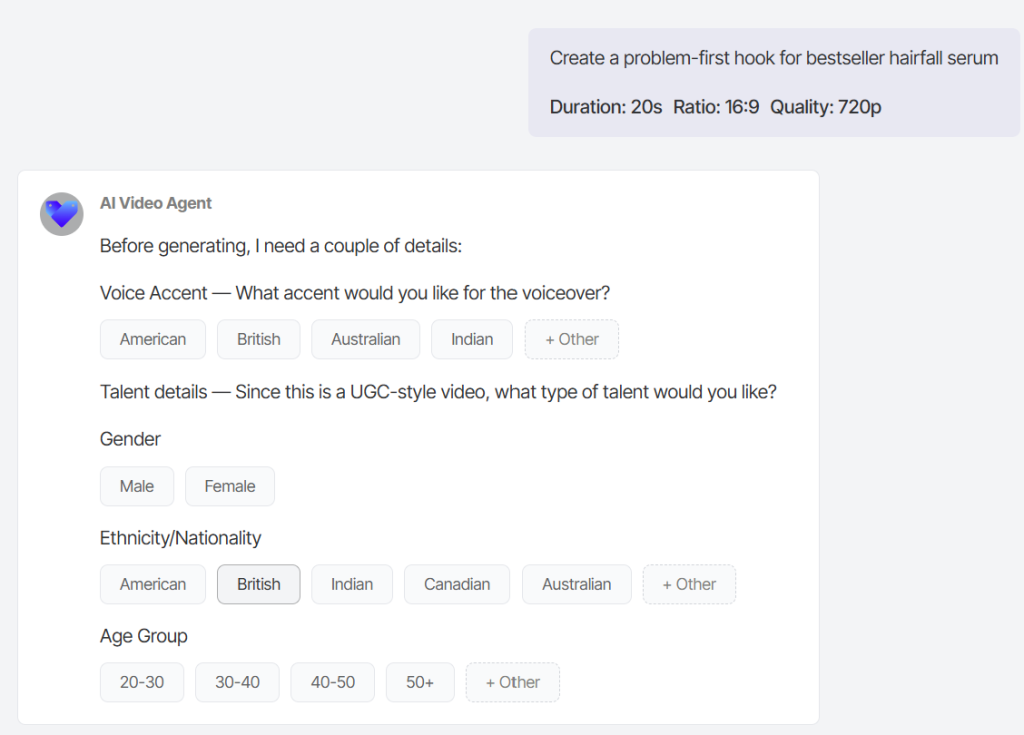
Step 2: Batch the follow-ups and storyboard review by account.
Review multiple storyboards for the same client in one sitting rather than context-switching between five different brand voices in the same hour, that’s where “everything starts sounding the same” mistakes actually happen.
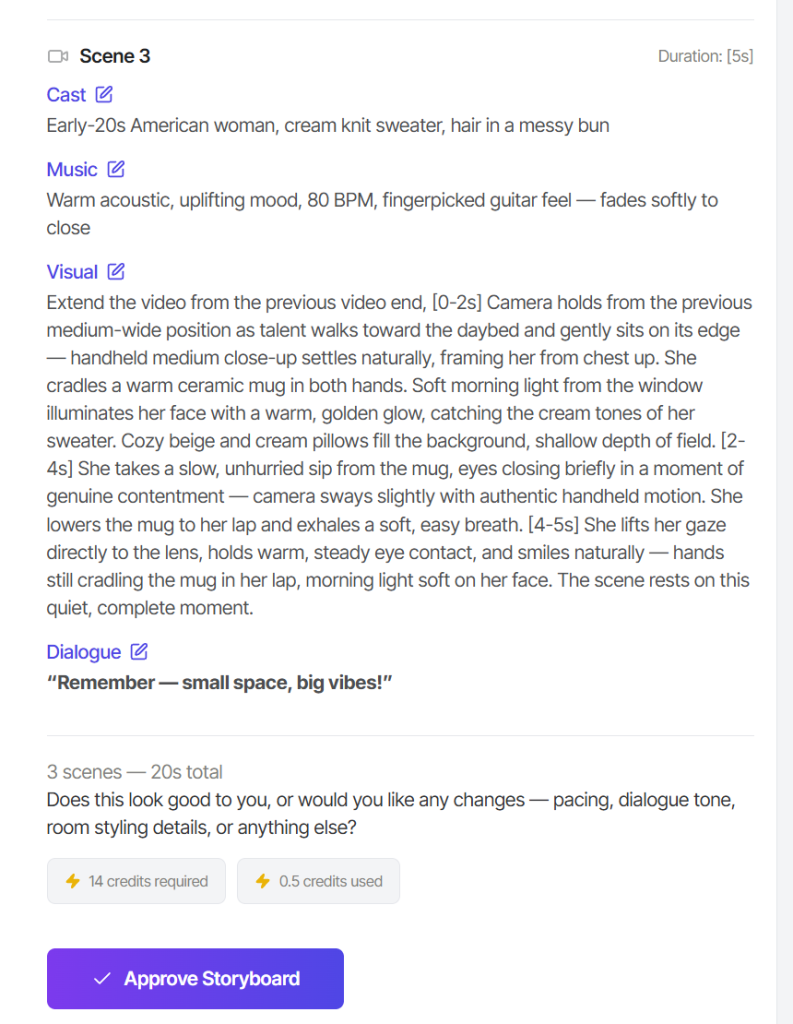
Step 3: Proofread and Approve Storyboard
Approve in volume, then let each client’s own performance data pick the winners. This is where the 4-8% “winner” stat becomes useful instead of scary: if you know only a small fraction will win, generating in volume per client isn’t wasteful; it’s the actual strategy.
Steal These Prompts (Built for Account Managers, Not Just Creatives)
The retainer-renewal prompt (for a client review call):
“Create three UGC-style variants of [client]’s current best-performing product, each with a different hook angle: problem-first, skeptic’s-honest-reaction, and quick-win demo. Generate before the client call, not after they ask.”
The multi-brand-voice check prompt:
“Create a UGC-style video for [client] using their standing brand brief: [tone, banned phrases, audience]. Keep the pacing and presenter energy distinct from [other client]’s recent videos so the two don’t read as interchangeable.”
The local/service-business prompt:
“Create a UGC-style video for [local service client] where the creator addresses a specific, common objection [name it] before showing the service or result, ending with a direct, low-pressure CTA suited to a local audience rather than a national brand tone.”
5 Rules for Running AI UGC Across Multiple Clients Without Losing Brand Voice
Keep a standing brief per client, and actually reuse it.
The single biggest risk at agency scale isn’t AI content looking fake; it’s every client’s content starting to sound the same. A written brief per account prevents that drift, and it’s the single factor practitioners running dozens of these campaigns point to most often when explaining why some batches perform and others don’t.
Pair the AI-generated hook with real product footage once an angle wins.
Pure AI end-to-end is the right call for cheap, fast testing. Once a hook proves itself, the hybrid version, AI hook plus real footage, is what practitioners actually scale spend behind, not the fully synthetic version.
Cut losers within 24 to 48 hours, not at the end of the month.
That’s the window that shows up consistently across agencies actually running high-volume AI UGC. Waiting longer just delays finding the next winner.
Review storyboards in client-batches, not creative-batches.
Reviewing five storyboards for one client back-to-back catches tone drift faster than reviewing one storyboard each for five different clients in a row.
Build disclosure into the default workflow, not into memory.
Don’t rely on each account manager remembering which client’s industry needs consumer-facing disclosure. Bake the check into the standard process for every new asset.
Use the volume to renew retainers, not just to hit deadlines.
Walking into a client review with three tested angles instead of one finished asset directly answers the “proactivity” complaint that’s the top reason clients actually leave.
Let performance data decide the winner, not internal taste.
With only 4 to 8% of any batch expected to be a real winner, an account team’s favorite variant is a guess like any other until the data says otherwise.
The Real 10x for Agencies Isn’t More Output. It’s This.
The volume math is real: more clients means more required creative, multiplied, not added. But the actual unlock for agencies isn’t producing more videos. It’s producing enough tested variants, per client, fast enough that “we’re already testing three new angles” becomes the answer to a client’s “what’s new this month” before they even have to ask. That’s the difference between a retainer that gets renewed and one that gets reviewed.
Frequently Asked Questions
Yes, this is one of the most common agency use cases. Just be transparent with the client that the underlying production method is AI-generated, even if the agency’s own branding is what the client sees, since that trust gap is what causes problems later, not the tool itself.
There’s no universal number, it depends on account complexity and revision volume, but the honest way to calculate it is to look at your current refresh cadence needs (roughly every 2 to 4 weeks per active client before creative fatigues) and multiply by however many accounts one person is assigned, then compare that to how many hours the same volume would take to hand-produce. That gap is the real capacity increase.
Both should know it’s AI-generated internally as standard practice. Whether the end consumer needs a visible disclosure depends on the client’s industry, real estate and health-adjacent categories carry the most legal and trust risk, and that responsibility should be built into the agency’s default workflow rather than left to individual account managers.
No. It replaces the production bottleneck, not the judgment call of which angle a specific client’s audience actually needs, or when a brand voice is drifting. Agencies that treat it as a strategy replacement tend to be the ones whose clients start sounding interchangeable, which is the exact problem this format is supposed to solve.
Track cost-per-creative and time-to-launch against your previous production model, the way WhiteDigital documented over $120,000 in quarterly savings and a 4.2x ROI increase. Those two numbers (cost saved, ROI change) are what actually justify the shift to skeptical stakeholders, more than any claim about video quality.
Many are moving away from billing per finished asset toward billing for a testing process, a set number of variants tested per week or month, with a smaller separate fee for reshooting confirmed winners with real creators. Billing the old way (per finished video) tends to undersell the actual value once production cost drops this much.
Written by:

Prakash Rawat is a digital marketer at Tagshop AI with 6+ years of experience across SEO, performance marketing, and AI-powered growth tools. He specializes in applying AI-driven strategies to optimize visibility, accelerate scalable growth, and drive adoption of next-generation marketing technologies.
 Add Tagshop.ai as a preferred source in Google Search






 Introducing

 Wan 3.0 is now live on Tagshop AI