How to Create AI UGC Ads for SaaS Applications That Convert
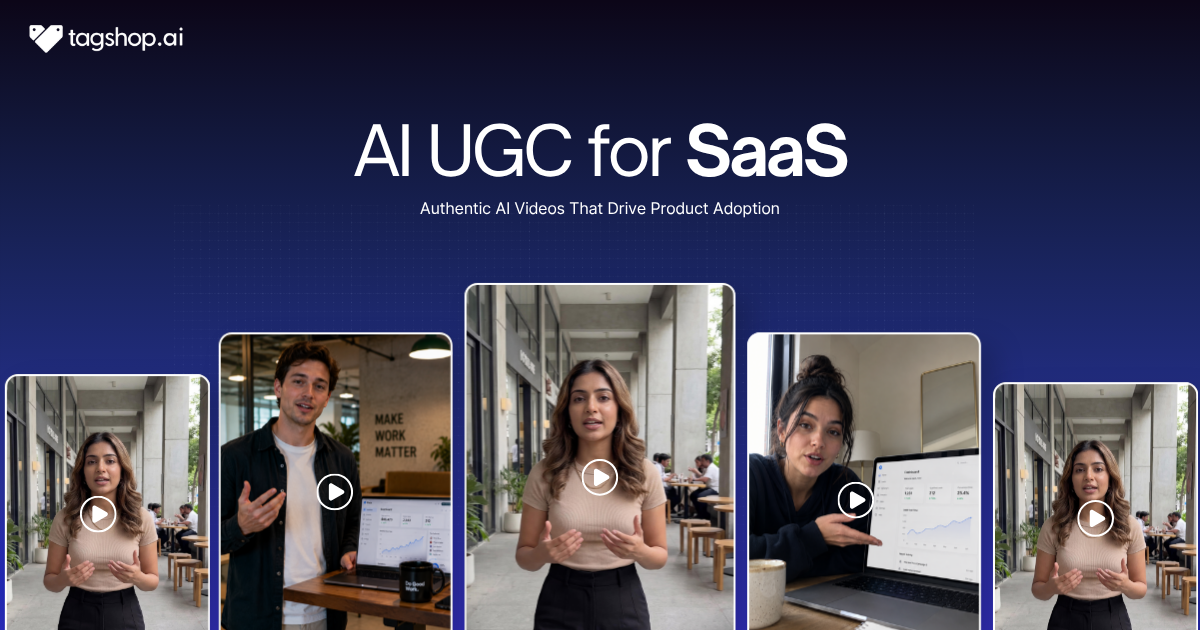







TL;DR: SaaS has a content problem other categories don’t: there’s no physical product to film, the value is often invisible until someone’s actually inside the dashboard, and a traditional explainer video costs $5,000 to $15,000 and takes weeks to produce, way too slow to test which angle a buyer actually responds to.
AI UGC solves the speed problem: generate 10 to 20 cheap hook variants in a day instead of one expensive video in a month. But here’s the part most posts on this topic won’t tell you: AI UGC does not reliably beat human UGC on performance. Marketers report wildly different results; some see AI avatars winning split tests, others see human creators beating AI by 10x on CTR. The winning approach isn’t “replace human UGC with AI.”
It’s using AI as the fast, cheap testing layer, then handing the winning angle to a human creator (or scaling the AI version, if it’s the one actually winning) for the real spend.
Every SaaS Marketer Says the Same Three Things
Run enough SaaS marketing conversations and these three come up constantly:
- “Our product isn’t visual. It’s hard to make scroll-stopping content out of a dashboard.”
- “We can’t justify paying a UGC creator for an angle that might completely flop.”
- “A proper explainer video costs five figures and takes a month. We need to know if the angle works before we spend that.”
None of these are really about video production. They’re about the cost of finding out whether an angle works, before you’ve committed real budget to it.
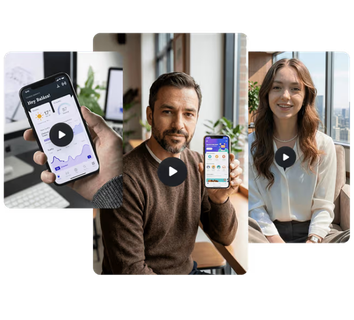
Why One Explainer Video Was Never Going to Be Enough
A single polished explainer video assumes you already know the right pain point, the right proof, and the right audience. Most SaaS teams don’t know that until they’ve tested it. And the traditional model makes testing expensive by design: one 90-second explainer runs $5,000 to $15,000 and takes weeks, so most teams only get one or two shots a quarter to find the angle that actually lands.
Meanwhile the buyer journey itself rewards a different kind of content entirely. Demo-to-paid conversion sits at a median of roughly 32% (top quartile 48%+), nearly double the median free-trial-to-paid conversion of around 8 to 18%. In other words, getting the right person to a demo is worth far more than getting anyone to sign up for a trial, which means the job of your ad content isn’t just “get clicks.” It’s “get the right buyer to want to see this live,” and that takes more angle-testing than one expensive video can give you.
The Honest Truth: AI UGC Doesn’t Always Beat Human UGC (Here’s When It Does)
This is the part most “AI UGC for SaaS” content skips, and it’s the part that actually matters if you don’t want to waste budget.
Search how SaaS marketers actually talk about this and the data is genuinely mixed. One agency reported AI avatar ads outperforming human UGC on CTR in 11 of their last 20 split tests, a real, meaningful win rate. Another founder running ads for a micro-SaaS product reported the opposite outcome entirely: a real actor UGC video hit a 5.8% CTR while the AI-generated version managed just 0.3%, a massive gap in the other direction.
The difference isn’t the technology. It’s how it’s used. The workflow that consistently shows up in SaaS marketing communities is what’s often called the testing funnel: generate 10 to 20 low-cost AI hook variants first, let the data show which pain point and angle actually resonates, then either scale the AI version if it’s winning, or hand that specific winning angle to a human creator for the final, higher-spend version. AI UGC’s real strength for SaaS isn’t being a permanent replacement for human creators. It’s a cheap, fast filter that tells you which angle deserves a real budget before you spend it.
“We had a founder swear their onboarding-pain hook would win. It came in fourth out of five. The one that won was a screen recording of a feature they almost cut from the video. I’ve seen that exact pattern enough times now that I don’t trust my own first instinct on an angle anymore, I just test it.”Neeraj Singal – Founder, Tagshop AI
What AI UGC Actually Fixes (And Where It Still Needs You)
Once you treat it as a testing layer rather than a finish line, the value is clear:
- You can test a pain-point-first hook, a feature-proof hook, and an outcome-first hook in the same week, instead of picking one and hoping.
- Screen-recording-style product walkthroughs and AI avatar explainers can be generated for every core feature, not just the one your last video happened to cover.
- Localized or persona-specific variants (SMB buyer vs. enterprise buyer, technical vs. non-technical) can be generated without re-scripting from scratch each time.
What it doesn’t remove is judgment. Deciding which pain point is actually worth testing, and recognizing when an angle has genuinely won and deserves a polished human-creator version, is still the marketer’s call.
Inside the Workflow: From Product Link to Feature Demo Ad
Using Tagshop AI’s Video Agent 2.0 as the practical reference for SaaS specifically:
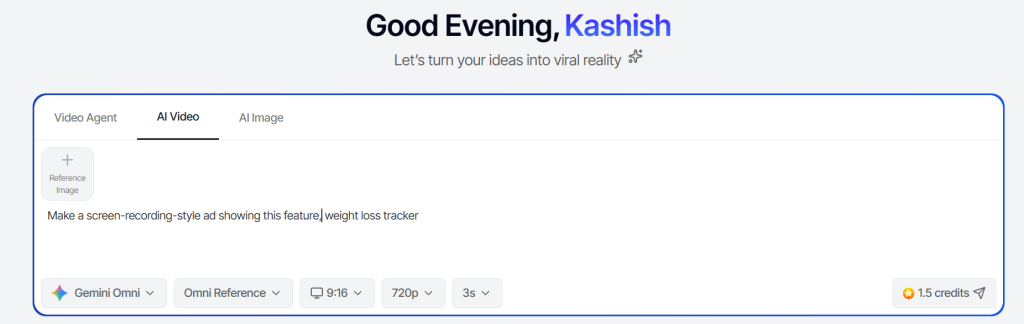
Step 1: Give it Your Idea and Your App
Type what you want in plain language, something like “make a screen-recording-style ad showing this feature solving [specific pain point].” Paste the product link, or upload a screenshot or screen recording of the feature you want to highlight, and set your length, anywhere from 4 to 60 seconds. Shorter usually wins for a quick-win demo hook; the longer end gives room for a pain-point-first hook to build before the payoff.
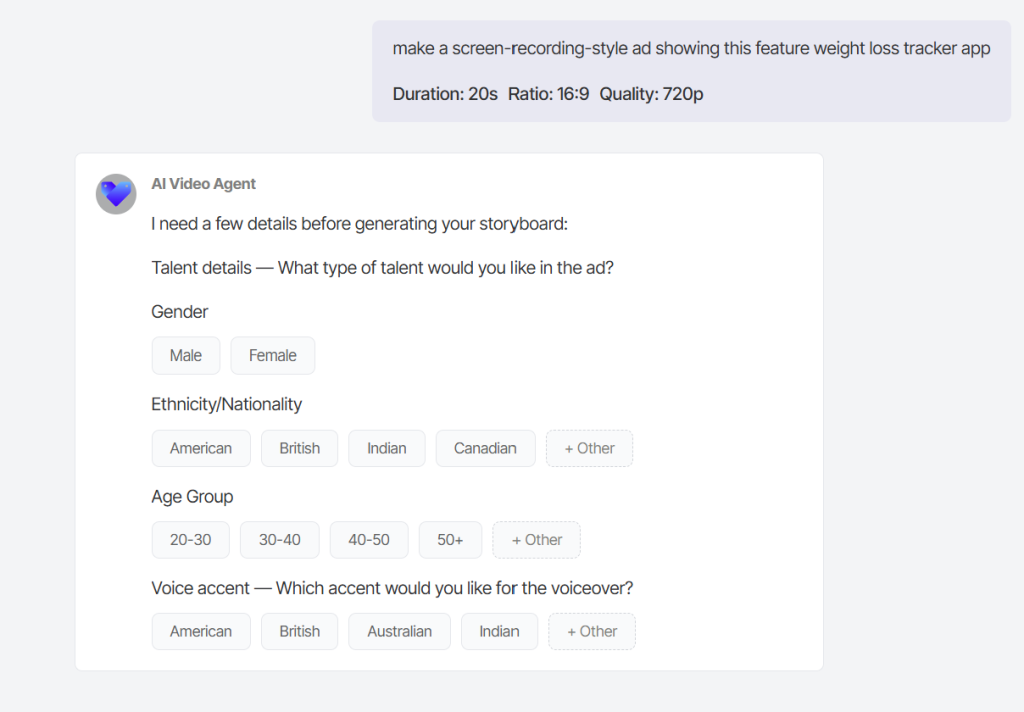
Step 2: Answer the Follow-ups, and Review the Storyboard
The Agent asks about your audience and message, brief it like you’d brief a real creator: what pain point opens the video, what proof comes next. Then review the scene-by-scene storyboard before it renders, this is where you pick the format mix (pure avatar talking-head, avatar-plus-screen-share, or avatar-plus-product-b-roll), since pure talking-head avatars alone tend to fatigue audiences fast. Adjust directly: “cut the intro, open on the screen recording instead.”
Step 3: Generate, fine-tune, and post.
Approve the storyboard and generate multiple angle variants in the same session rather than one polished version, regenerate just the scene that’s not landing if needed, then push the batch to test and treat the winner as the one that earns a bigger budget next.
Steal These Prompts for Your Next SaaS Ad
The pain-point-first hook:
“Create a UGC-style video where the creator opens with a specific, relatable frustration [name the exact workflow pain point], then shows [product] solving it via a quick screen recording of the actual feature, ending with a direct ‘try it free’ CTA. Casual tone, not a polished corporate voiceover.”
The skeptic’s proof hook:
“Create a video where the creator says they were skeptical [product] could actually do X, then shows the real dashboard or feature in action to prove it, giving a specific, honest reaction rather than generic praise.”
The persona-specific hook:
“Create a UGC-style video speaking directly to [SMB founders / enterprise ops teams / technical buyers], framing [product]’s value around the outcome that specific persona cares about most, not a generic feature list.”
The quick-win demo hook:
“Create a fast-paced, under-20-second video showing [product] solving one specific task in real time (screen recording style), with on-screen text calling out the before/after time saved.”
Must Explore: AI Video Templates for Applications
5 Rules for SaaS AI UGC That Doesn’t Feel Like Filler
- Treat AI UGC as your testing layer, not your final scaled asset, until the data says otherwise. Generate cheap variants first. Only put real budget behind the angle that’s actually proven itself.
- Mix formats. Don’t lean on pure talking-head avatars alone. Screen recordings, dashboard walkthroughs, and text overlays keep the content from feeling like filler, and audiences fatigue on avatar-only content fast.
- Lead with the pain point, not the feature list. The consistent formula across SaaS-specific UGC discussions is: sharp pain-point hook, quick product proof, direct outcome CTA. Feature dumps convert worse than a specific “here’s the exact thing I was stuck on.”
- Be upfront that it’s AI-generated when it’s a clear avatar presentation. Some SaaS marketers building AI UGC tools are baking in explicit “made with AI” labeling by default. It costs you very little and it protects trust, especially with a technical, skeptical B2B audience that will notice and call it out if you don’t.
- Don’t assume AI will outperform human creators, and don’t assume it won’t. The actual reported results are split both ways. Test both, on your specific product and audience, before deciding which one gets the real budget.
The Real 10x Isn’t More Ads. It’s This.
The math that actually matters here isn’t “AI content converts better.” It’s that testing an angle used to cost $5,000 to $15,000 and a month, and now it costs a fraction of that and a day. Teams that win with this aren’t the ones assuming AI UGC automatically outperforms a human creator. They’re the ones using AI UGC to find the pain point and hook that actually works, fast and cheap, then putting real budget (AI-generated or human-creator) behind the version the data already proved.
Must Explore: Tech AI Video Templates
Frequently Asked Questions
It depends, and the data is genuinely split. Some SaaS marketers report AI avatar ads winning the majority of their split tests against human UGC; others report human creators outperforming AI content by 10x on click-through rate. The safest approach is testing both on your specific product and audience rather than assuming either one wins by default.
Start by generating 10 to 20 low-cost hook variants around different pain points and proof formats (screen-recording demo, sceptic’s honest reaction, persona-specific framing) before committing to one polished version. Let click and demo-request data tell you which angle is actually worth scaling.
There’s no universal legal requirement the way there is in, say, real estate listings, but B2B and technical audiences tend to notice and react negatively to undisclosed AI avatars more than most consumer audiences. Several SaaS-focused AI UGC tools now build in an explicit “made with AI” label by default for exactly this reason.
A traditional 60 to 90 second SaaS explainer video typically costs $5,000 to $15,000 and takes several weeks to produce. AI UGC tools can generate multiple variant angles for a small fraction of that cost, often within the same day, which is what makes angle-testing realistic before committing to a bigger production spend.
Demo-to-paid conversion (median around 32%, top quartile 48%+) is significantly higher than free-trial-to-paid conversion (median roughly 8 to 18%), so for higher-ACV products, content that earns a demo request tends to be worth more than content optimised purely for trial signups. Lower-priced, self-serve products are the exception where trial-first content still makes sense.
Written by:

Neeraj is passionate about reshaping brand storytelling through AI-powered UGC videos. As the Founder he helps brands unlock authentic, creator-style video content that drives results - without the traditional time, cost, or complexity. His approach blends AI innovation with marketing performance to scale engagement efficiently.
 Add Tagshop.ai as a preferred source in Google Search






 Introducing

 Wan 3.0 is now live on Tagshop AI