How to Make AI UGC Videos for Personal Care Products
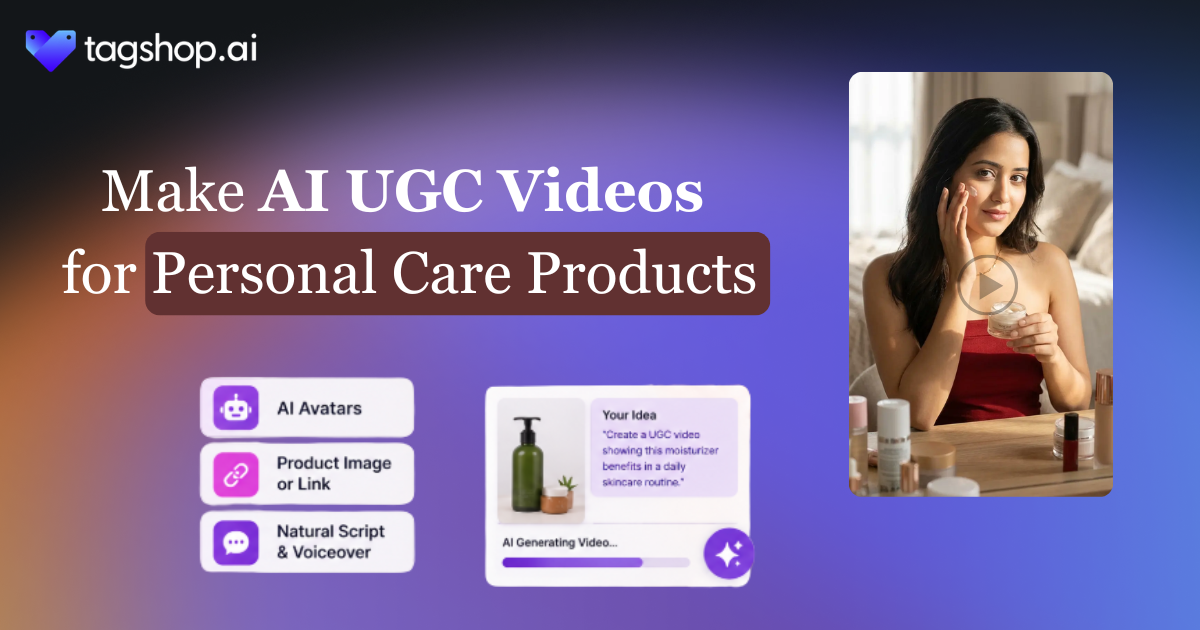







Great UGC is the hardest thing to ask for and the easiest thing to lose sales without.
You know what works.
A real person, real skin, real reaction, talking about your product genuinely. This type of content builds more trust in 30 seconds than a month of brand posts. The problem is you can’t manufacture it. You can’t schedule it. And chasing customers or creators for video reviews is a full-time job that rarely pays off the way you need it to.
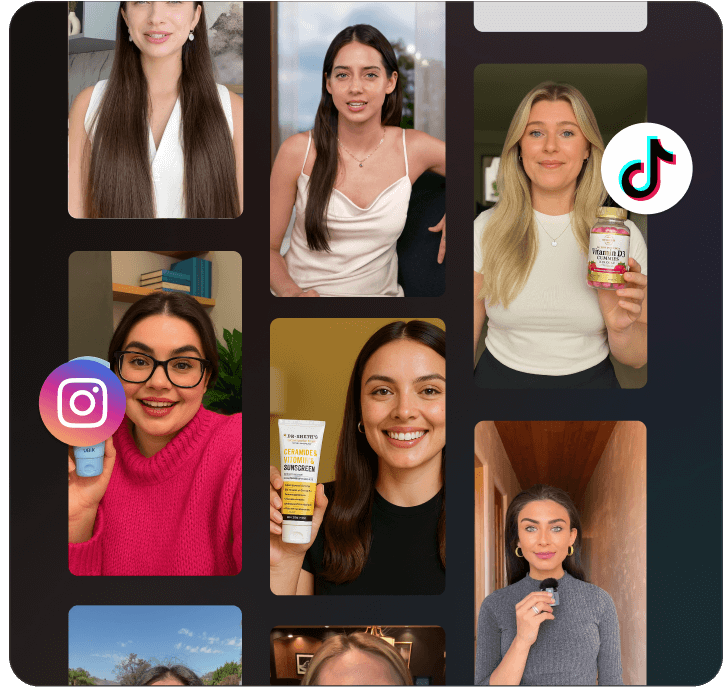
That’s where AI UGC comes in. Personal care brands are now generating creator-style videos in minutes — routines, demos, testimonials, and unboxings that carry the same trust signals as real customer content, without the wait, the cost, or the unpredictability. For a full primer before diving in, read our guide on what AI UGC is and how it works for product brands.
This guide covers why AI UGC works specifically in personal care, and how to build a strategy around it using Tagshop AI.
What is AI UGC content?
AI UGC are videos created by AI that feature AI-generated avatars or characters promoting a certain good or service. This is a modern way of advertising that feels like authentic creator content without involving a real creator.
The output looks the same as a creator filmed on their phone, and sometimes even better. The difference is that it takes minutes to produce, costs under a dollar per video, and does not depend on anyone opting in to create it.
Traditional UGC vs AI UGC
AI UGC Content source AI avatars with scripted voiceovers Production time Days to weeks Under minutes Cost per video $300 to $800$1 to $20 per video Scalability Low, depends on customer participation High, unlimited on demand quality control unpredictable consistent A/B testing slow and expensive fast, multiple variations in minutes language support: 75+ languages without separate shoots trust signal High, with real experiences High, when scripted authentically Best use case Social proof, organic reach volume, testing, new product launches, and multilingual campaigns
Why AI UGC is growing fast in personal care
The shift started with the platforms. TikTok works around short-form, demonstration-first content. Instagram Reels reward videos that feel native and unique. Audiences skip anything that looks like an ad within the first two seconds.
36.8% of successful beauty advertisements in 2026 featured UGC-inspired creativity. This is the dominant style of advertisement that performed better than all other formats — including studio videos, animation, and statics.
AI UGC has sped up the shift by solving the four biggest content bottlenecks personal care brands face:
Faster production: under a few minutes from idea to finished video, compared to weeks for traditional creator content.
Costs reduced: AI UGC costs a fraction of traditional creator rates.
A/B testing made easier: produce 10 versions of the same video with different hooks, and let the data decide.
Multiple language content creation: launch campaigns in 75+ languages without multiple shoots.
Why AI UGC works especially well for personal care
Consumers want demonstrations. In personal care, showing the product working will always outperform talking about it. An avatar demonstrating a skincare ritual, responding to product texture, and sharing a before-and-after — that’s the way to go.
In 2026, 38.8% of the best-performing beauty commercials included visual product demonstration. Companies that opted for product demonstration kept their campaigns running longer.
Short-form videos lead the category. TikTok, Instagram Reels, YouTube Shorts, and Facebook are the channels to promote personal care products. They all favor short, native-feeling video. AI UGC is built for exactly this format.
Common use cases in personal care marketing
Product testimonials, skincare routine videos, haircare transformation videos, Get Ready With Me (GRWM) videos, before-and-after videos, product demonstration videos, unboxing videos, problem-solution videos, multilingual UGC advertising, and avatar representative videos.
How to plan your AI UGC video strategy
Define your goal
Brand awareness, education, and conversion require unique strategies. A cold audience will require content that earns their attention before getting their click. The warm retargeting audience, on the other hand, will require a strong testimonial with a clear call to action.
Identify your target audience
Age, skin type, hair concerns, and lifestyle all shape which avatar you pick inside Tagshop AI. The more specific you are, the better the output.
Video styles per funnel stage
Top of funnel: problem-solution and testimonial videos. Middle of funnel: routine and demo videos. Bottom of funnel: unboxings and GRWM content for warm audiences who already know the product.
Choose the right products to feature
Start with bestsellers and high-margin products. New launches are also a strong use case as they have no reviews yet.
How to create AI UGC videos with Tagshop AI
Tagshop AI’s video agent removes the barrier of creating AI UGC manually. You don’t need a finished script, a creative brief, or a production team. You only need to chat with the agent — it builds the rest with you.
Step 1: Start with a simple idea
Type anything into the agent: a product name, a link, a campaign angle, a rough thought. The agent takes over from there.
Step 2: Interact with the AI video agent
The agent asks questions about your product, target market, voice, and social media channels. In light of your responses, the agent crafts a UGC-oriented script tailored for TikTok, Instagram Reels, or YouTube Shorts.
Step 3: Create and post
Click Generate Video. Tagshop AI produces a creator-style video in minutes. Edit inside the built-in editor with auto-captions, text overlays, and platform formatting. Then export in platform-native format and publish. No third-party editing software needed.
Best practices for AI UGC in personal care
Avoid overpromising results. Realistic claims convert better than dramatic ones in personal care.
Keep claims specific. Frame outcomes as personal experience, not universal guarantees.
Test different hooks. The first three seconds decide whether someone stays or scrolls.
Optimize for each platform separately. A 45-second routine video works on YouTube Shorts. That same video needs to be 20 seconds for TikTok.
Common mistakes to avoid
Overusing AI effects. Heavy filters and synthetic backgrounds break the UGC format.
Skipping product demonstration. Get the product into the video early and show it in use.
Long intros. Open with a result, a problem, or a reaction. Not pleasantries.
Weak calls to action. The CTA should feel like the natural end of the story.
Benefits of AI UGC for personal care brands
Faster content production: From idea to published video in minutes.
Easier scaling across the catalog: Every SKU gets video coverage.
Multilingual campaign creation: 75+ languages without separate productions.
Rapid creative testing: Ten variations of one ad, running simultaneously.
Also worth reading: AI UGC for health and fitness brands covers very similar tactics for the wellness category. For beauty and cosmetics, see our guide to AI UGC for beauty and cosmetic brands. And to compare your options before choosing a tool, see the best AI UGC tools for personal care brands.
Conclusion
AI UGC is not a shortcut. It is a more efficient production system for brands that already know what kind of content works, but cannot produce it fast enough or cheaply enough through traditional means.
For personal care brands specifically, AI UGC covers the format that converts best in the category. With Tagshop AI, the workflow is straightforward: drop a product link or idea into the video agent, chat through your goals, and walk away with a publish-ready video. Start with your bestselling product, test variations, and scale what the data supports.
Frequently Asked Questions
Yes. UGC-style video was the top-performing ad format in beauty in 2026, making up 36.8% of winning ads across 500 top campaigns.
Tagshop AI is the strongest purpose-built option with AI video agent, 1,000+ avatars, URL-to-video automation, AI Twin for consistent brand identity, and 75+ languages in one platform. For personal care brands selling across markets, it is the most practical choice available.
Not entirely. Real customer content carries the highest trust signal in personal care, where individual results vary. AI UGC handles volume and testing at a speed human creators cannot match. The two work better together than either does alone.
As many as you need. With Tagshop AI, there is no limit on variations. You can generate multiple videos for the same product with different avatars, hooks, tones, and formats. Most brands create five to ten variations per product to A/B test across platforms and scale what performs.
Written by:

Kashish Vaswani is a Content Strategist at Tagshop AI, specializing in AI-powered marketing, UGC advertising, and eCommerce content. She creates actionable guides, industry insights, and product-focused resources that help brands, marketers, and creators leverage AI to produce high-converting video ads and scale their content strategy with confidence.
 Add Tagshop.ai as a preferred source in Google Search





 Introducing

 Wan 3.0 is now live on Tagshop AI